
A noisy garage door almost always comes down to one of a few things: dry or worn rollers, loose hardware, a track problem, a struggling garage door opener, or a broken spring. The specific sound tells you which. Light squeaks and rattles are usually a maintenance issue you can handle with lubricant or a socket wrench. A sudden loud bang, a metallic grinding, or a straining motor points to a worn or broken part that needs a technician. The rule of thumb: if the door still moves smoothly and the noise is minor, it is maintenance. If the movement changed along with the sound, stop using the door and get it looked at. In most cases a noise is a simple repair, but if the door is old and the problems keep stacking up, it may be pointing you toward a garage door replacement.
Key takeaways
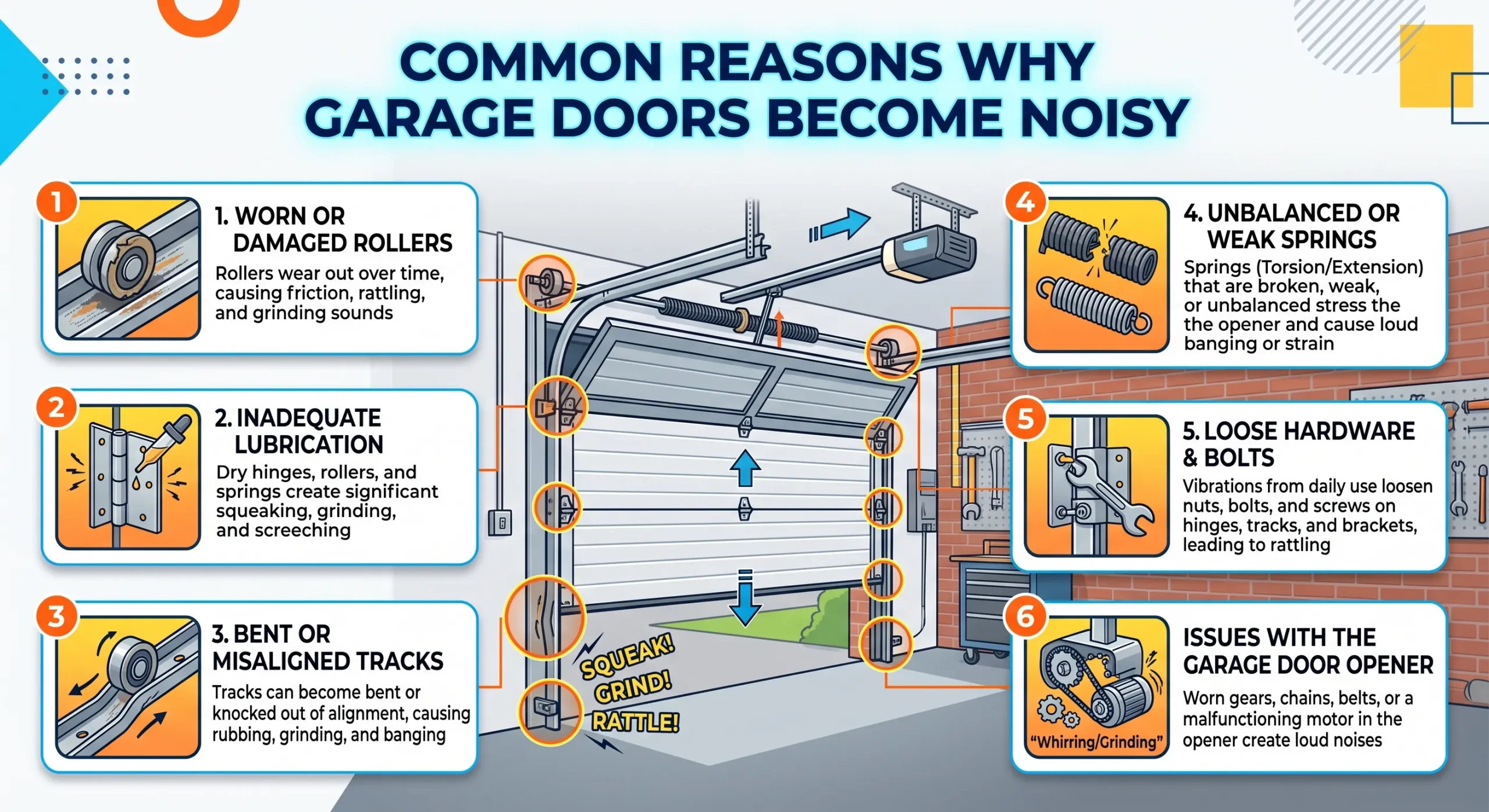
- The type of sound is the fastest diagnostic tool you have. Squeak, grind, rattle, and bang each point to different parts.
- Squeaking and rattling are the most common and the most DIY-friendly, usually just dry parts or loose bolts.
- A single loud bang often means a broken spring. This is the one sound you should treat as urgent, not a nuisance.
- Never spray WD-40 on garage door parts. It strips lubrication and attracts grit. Use a garage-door-rated silicone or lithium spray.
- Never touch the springs or cables yourself. They hold extreme tension and cause serious injuries every year.
- Most noises get quieter with routine maintenance. If a sound is new, sudden, or paired with slower or jerky movement, call a pro.
1. Squeaking or squealing
Symptom: A high-pitched squeak or squeal as the door rolls up or down, often worse in cold weather.
Most likely cause: Dry rollers, hinges, and bearings. This is the single most common garage door noise and, in most homes, the least serious. Metal parts that have gone without lubrication rub and vibrate at a high frequency.
Fix steps:
- Close the door and unplug the opener.
- Wipe the tracks clean with a dry cloth. Do not lubricate the tracks themselves, only the moving parts.
- Apply a garage-door-rated silicone or white lithium spray to the rollers, hinges, springs, and bearing plates.
- Open and close the door a few times to work the lubricant in.
Regular lubrication is part of a good annual maintenance routine and prevents most squeaks before they start.
Call a pro if: The squeal continues after lubrication, or you have nylon rollers that look cracked or flat-spotted. Worn rollers need replacement, not just grease.
How to fix a squeaking garage door
If the squeak is just dryness, a proper garage-door lubricant on every hinge, roller, and bearing usually silences it within one or two cycles. If it comes back within a few weeks, the rollers are worn and should be swapped out. We cover this in depth in Why Does My Garage Door Squeak So Loud? 6 Fixes That Actually Work.
2. Grinding
Symptom: A rough, metal-on-metal grinding as the door moves, sometimes with a gritty feel.
Most likely cause: Worn metal rollers running in a dry or dirty track, or a stripped drive gear inside the opener. Grinding means two hard surfaces are dragging against each other with no cushion in between.
Fix steps:
- Watch the door move (from a safe distance) and listen for where the grind is loudest: at the rollers or up at the opener motor.
- If it is the rollers, clean the tracks and lubricate the rollers and bearings. Worn steel rollers should be replaced with nylon.
- If the grinding is at the opener and the door barely moves, the drive gear is likely stripped. Stop using the opener.
If the noise traces back to the opener rather than the door, our guide on a garage door opener that stops working walks through the internal causes.
Call a pro if: The grind is coming from the opener, the rollers are visibly worn, or lubrication does not quiet it. A stripped opener gear and worn rollers both need parts.
How to fix a grinding garage door
The fix depends entirely on the source. Track and roller grinding responds to cleaning, lubrication, and roller replacement. Opener grinding usually means an internal gear has failed and the unit needs service. Full breakdown in Why Is My Garage Door Grinding? 5 Causes and How to Fix It.
3. Rattling or vibrating
Symptom: A rattling, clattering, or vibrating sound, like something is loose and shaking as the door travels.
Most likely cause: Loose hardware. Garage doors cycle thousands of times a year, and that vibration slowly backs out nuts, bolts, and screws on the hinges, brackets, and track supports.
Fix steps:
- Unplug the opener and close the door.
- Go over every visible nut and bolt on the hinges, roller brackets, and track mounts with a socket wrench.
- Snug each one. Do not overtighten, which can strip the hole or crack a hinge.
- Check that the track mounting brackets are tight to the wall and ceiling.
Call a pro if: The rattle continues after everything is tightened, or you find bolts on the spring assembly or bottom brackets that seem loose. The bottom brackets are under spring tension and are not safe to adjust yourself.
Why is my garage door rattling when it opens
A rattle almost always traces back to loose fasteners somewhere in the door hardware, and a ten-minute pass with a socket wrench fixes most of them. If it persists, the track may be slightly bent or a roller may be loose in its bracket, which is worth a professional look. You can see how the pieces fit together in our anatomy of a garage door overview.
4. Banging or a loud pop
Symptom: A single sharp bang or loud pop, often heard when the door is not even moving, or a heavy bang as the door opens or closes.
Most likely cause: A broken torsion spring. When a spring snaps it releases its tension all at once, which sounds like a firecracker or a car backfiring. A banging door during travel can also mean loose panels, a bent track, or, in winter, sections contracting and sticking in the cold.
Fix steps:
- Stop using the door immediately. Do not try to open it with the opener.
- Look at the springs above the door. A broken spring will have a visible gap, like a spring cut in two.
- If a spring is broken, leave the door closed and call a technician.
- If the springs look intact, the bang may be cold-weather contraction or a loose panel, which is less urgent but still worth inspecting.
For the winter version of this problem, see why your garage door will not close in cold weather. To confirm a broken spring, our guide on how to know if a garage door spring is broken shows exactly what to look for.
Call a pro if: You suspect a broken spring, always. Springs hold enough tension to cause serious injury, and this is one of our most common emergency calls. Do not attempt a spring repair yourself. See our broken spring emergency guide.
Why does my garage door bang when it opens or closes
A loud bang is the one noise we tell homeowners never to ignore. Most of the time it is a broken spring, which is dangerous to handle and needs same-day service. Cold-weather banging and loose panels are less urgent but still point to something that should be tightened or adjusted. Full detail in Why Does My Garage Door Bang When It Opens or Closes? 5 Likely Causes.
5. Rumbling or thumping
Symptom: A deep rumble or repeated thumping as the door rolls, like it is bumping over something.
Most likely cause: Worn rollers or a slightly bent track. When rollers develop flat spots or the track is dented, the door bumps at each rough spot instead of gliding.
Fix steps:
- With the door closed and opener unplugged, inspect the tracks for dents, bends, or debris.
- Check the rollers for flat spots, cracks, or wobble.
- Clear any debris and lubricate the rollers.
- Minor track debris you can clean. Bent track and worn rollers need replacement.
Call a pro if: The track is visibly bent or dented, or the rollers are worn. A misaligned track can eventually let the door come off its track, which is a bigger repair.
How to fix a rumbling garage door
Clean the tracks and lubricate the rollers first, since debris and dryness cause a surprising amount of rumble. If the sound stays, you likely have worn rollers or a track that has taken a knock and needs straightening or replacement, both of which are technician jobs. Rollers and related parts are covered in our garage door opener parts guide.
6. Clicking or clunking from the opener
Symptom: The opener clicks or clunks but the door does not move, or moves only slightly.
Most likely cause: A disengaged trolley, a stripped opener gear, or a problem with the drive system. The motor is running or trying to run, but the connection to the door is not transferring power.
Fix steps:
- Check whether the emergency release cord (the red handle) has been pulled, which disconnects the door from the opener. Re-engage it by pulling the cord toward the door and running the opener once.
- If it is still clicking with no movement, listen for whether the motor sounds like it is running freely (stripped gear) or straining.
- Do not keep pressing the button, which can burn out the motor.
Call a pro if: The trolley is engaged and it still clicks without moving. A stripped gear or bad logic board needs opener service. Our guide on what makes a garage door opener click but not open covers this exact symptom.
Why is my garage door opener clicking but not opening
Nine times out of ten, a clicking opener that will not move has either been knocked into manual mode by the emergency release or has a worn internal gear. Re-engaging the release is a free two-minute fix. A stripped gear or failing board is a repair-or-replace decision worth getting a professional opinion on. See when to stop using a LiftMaster opener for the replace side of that call.
7. Scraping or rubbing
Symptom: A scraping or rubbing sound, often on one side, like the door is dragging against the frame or track.
Most likely cause: The door is out of alignment, a roller has come partly out of its track, or the track brackets have shifted. The door is no longer traveling in a straight line.
Fix steps:
- Close the door and look at the gap between the door and the frame on both sides. An uneven gap points to alignment.
- Check that all rollers are seated in the track.
- Look for a track section that has drifted away from the wall.
- Minor debris in the track you can clear. Alignment and a roller that has jumped the track are not safe DIY fixes.
Call a pro if: The door is visibly crooked, a roller has left the track, or the track has shifted. A door that scrapes is on its way to coming off the track entirely.
How to fix a garage door that scrapes when it moves
Start by clearing the track and confirming every roller is seated. If the door is traveling crooked or a track section has moved, the alignment needs to be reset by someone who can safely release and re-tension the system. A scraping door left alone tends to get worse, so it is worth an early service call. Our Rockford repair steps walk through what a professional visit looks like.
8. Straining or humming motor
Symptom: The opener motor hums, strains, or labors, and the door moves slowly, unevenly, or not at all.
Most likely cause: The door itself is hard to move, so the opener is working too hard. This usually points to a spring losing tension, dry or binding tracks, or the door being out of balance. A humming motor that does nothing can also mean a bad capacitor.
Fix steps:
- Disconnect the door from the opener using the emergency release, then lift the door by hand.
- A properly balanced door lifts smoothly and stays put around waist height. If it is heavy or slams down, the springs are the problem, not the opener.
- If the door moves freely by hand but the motor still strains, the opener may have a failing capacitor or motor.
- Re-engage the opener when done.
Call a pro if: The door is heavy or unbalanced by hand (spring issue), or the motor hums without moving the door. Both need a technician. Do not adjust spring tension yourself.
Why is my garage door opener straining and slow
A straining opener is usually a symptom, not the disease. The most common root cause is a spring that has lost tension, which makes the door too heavy for the motor. Test the balance by hand as described above. If the door is heavy, the fix is spring service, not a new opener. If the door is light but the motor still labors, the opener itself is failing, and a garage door repair visit will confirm whether the unit can be serviced or needs replacing. A faulty capacitor or motor is often more cost-effective to resolve during the same visit as any other work, such as a new garage door installation, rather than as a separate trip.
DIY-safe vs. call-a-pro at a glance
Noise / issue | DIY-safe? | What to do |
Squeaking, mild | Yes | Lubricate rollers, hinges, bearings with garage-door spray |
Rattling / loose bolts | Yes | Tighten hardware with a socket wrench |
Rumbling from track debris | Yes | Clean tracks, lubricate rollers |
Clicking (emergency release pulled) | Yes | Re-engage the red release cord |
Grinding at the rollers | Sometimes | Clean and lubricate; replace worn rollers (pro) |
Grinding at the opener | No | Stripped gear, needs opener service |
Scraping / door out of alignment | No | Alignment and track repair are pro jobs |
Straining motor / heavy door | No | Spring tension issue, technician only |
Loud bang / broken spring | No | Stop using the door, call for emergency service |
Roller off the track | No | Do not operate the door, call a pro |
The bottom line
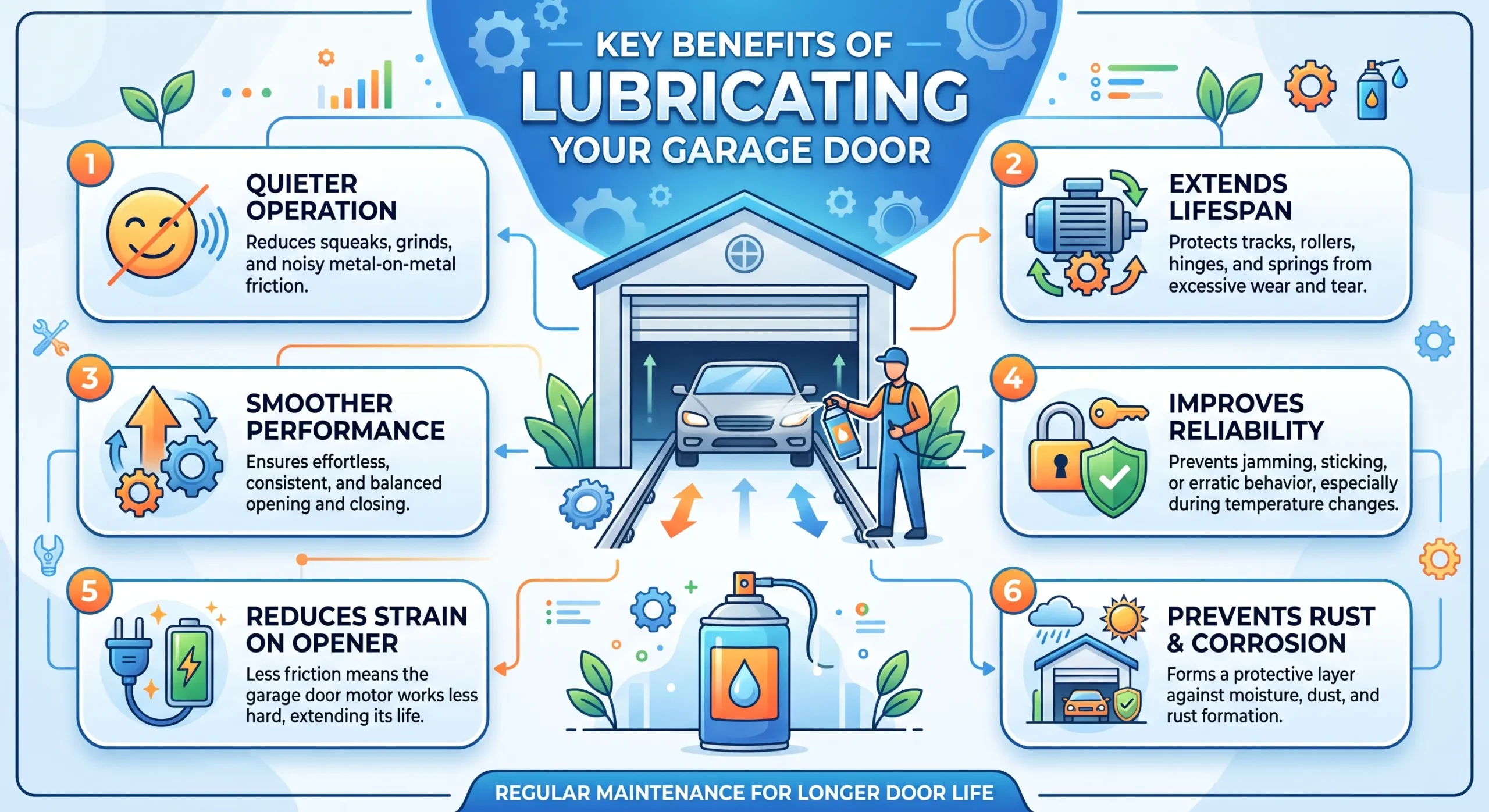
Most garage door noise is your door asking for basic maintenance, and a little lubrication and a socket wrench solve a surprising amount of it. The sounds that matter most are the sudden ones: a loud bang, a metallic grind from the opener, or a motor straining against a heavy door. Those point to worn or broken parts that are not safe to fix at home, especially anything involving the springs or cables. When you are not sure which camp a noise falls into, the safe move is to stop using the door and have it inspected.
If your garage door is making a noise you cannot place, or a sound that showed up suddenly, Rockford Door Company can diagnose it fast. Book a same-day inspection or request a free quote and we will tell you exactly what that sound means and what it will take to fix it.