
A loud bang from a garage door is different from a squeak or a grind: it is a sudden impact, not steady friction, and it usually means something let go or slammed. The five likely causes are a broken torsion spring, loose hardware or panels, worn rollers hitting the track, cold-weather contraction, and a garage door opener with its force or travel settings off. The most common and most serious is a broken spring, which makes a single sharp bang like a firecracker. If you hear that and the door will not open, stop and call a technician, because the springs are under extreme tension. A repeated bang during travel is usually loose parts or opener settings, which is less urgent but still worth fixing. Most banging is a repair rather than a replacement, but if a broken spring has slammed an already old, damaged door, it is worth asking whether a garage door replacement makes more sense than another repair.
Key takeaways
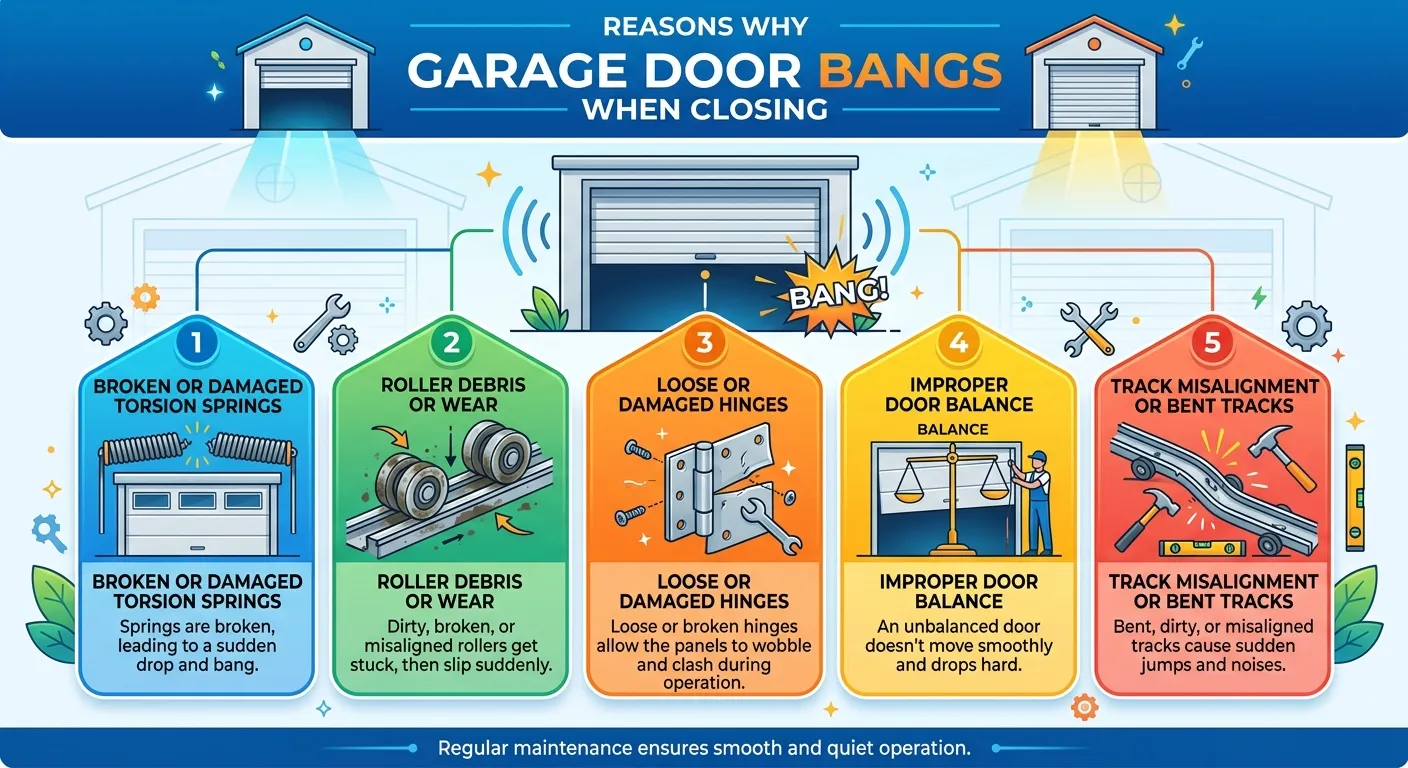
- A bang is a sudden impact sound, unlike the steady friction of a squeak or grind. Treat it more seriously.
- A single loud bang with the door then stuck is almost always a broken torsion spring. This is urgent.
- Never touch the springs or cables to investigate. They hold enough tension to cause serious injury.
- A repeated bang during travel is usually loose hardware, worn rollers, or opener settings, and is less urgent.
- In winter, cold-weather contraction can make a door pop or stick, a separate issue we cover in a dedicated guide.
- If the door slams shut fast, stop using it. That can mean a spring, cable, or opener-force problem, all pro repairs.
1. A broken torsion spring
Symptom: A single sharp bang, often like a firecracker or a gunshot, sometimes heard when the door is not even moving. Afterward the door is hard or impossible to open, or the opener strains and gives up.
Most likely cause: A broken torsion spring. When a spring snaps it releases all of its stored tension at once, which is the bang you heard. This is the most common cause of a loud garage door bang and the most serious. Without the spring, the door’s full weight is left on the opener or your hands.
What to do:
- Stop using the door immediately. Do not try to open it with the opener.
- Look at the springs mounted above the door. A broken spring shows a clear gap, like a spring cut in two.
- Leave the door closed and call a technician.
- Do not attempt to release, replace, or adjust the spring yourself.
To confirm what you are looking at, our guide on how to know if a garage door spring is broken shows exactly what to check, and what causes a broken garage door spring explains why they fail.
Call a pro if: You suspect a broken spring, always. This is one of our most common emergency calls, and it is never a safe DIY repair. See our broken spring emergency guide.
Why does my garage door bang and then not open
A bang followed by a door that will not open is the textbook sign of a broken torsion spring. The snap is the tension releasing all at once, and with the spring gone the opener can no longer lift the door’s weight. Do not force it. Leave it closed and get it serviced, because the remaining spring and the cables are still under dangerous tension.
2. Loose hardware or panels
Symptom: A repeated banging or clattering during travel, as if part of the door is slapping or shaking as it moves.
Most likely cause: Loose hardware. Thousands of cycles slowly back out the nuts, bolts, and screws on the hinges, brackets, and panels, and the loose parts bang against the door and frame as it moves.
What to do:
- Unplug the opener and close the door.
- Go over every visible nut and bolt on the hinges, roller brackets, and track mounts with a socket wrench.
- Snug each one without overtightening, which can strip a hole or crack a hinge.
- Check that the panels and struts are secure and not flexing.
You can see how the panels and hardware fit together in our anatomy of a garage door overview.
Call a pro if: The banging continues after tightening, a panel is cracked or bowing, or you find loose bolts on the spring assembly or bottom brackets. Those are under tension and are not safe to touch.
How to fix a garage door that bangs from loose hardware
A door that bangs steadily as it travels usually just has loose fasteners somewhere in the hardware, and a socket-wrench pass over every hinge and bracket fixes most of them. If a panel is flexing or cracked, or the banging survives tightening, the door needs a professional look before a loose part causes bigger damage.
3. Worn rollers hitting the track
Symptom: A banging or thumping at points along the door’s travel, as if the door is bumping over something.
Most likely cause: Worn or loose rollers. When rollers develop flat spots, crack, or wobble in their brackets, they bang against the track instead of rolling smoothly through it.
What to do:
- With the door closed and opener unplugged, inspect the rollers for flat spots, cracks, wobble, or missing bearings.
- Check that the tracks are free of dents and debris.
- Replace worn hinge-mounted rollers with nylon rollers for quieter, smoother travel.
- Do not touch the bottom-bracket rollers, which are under spring tension.
If the banging feels more like a steady grinding drag, that is a different sound covered in Why Is My Garage Door Grinding? 5 Causes and How to Fix It.
Call a pro if: The rollers are the bottom-bracket ones, the track is dented or bent, or you are not comfortable replacing rollers. A door with worn rollers can eventually jump the track.
How to fix a garage door banging on the track
Rollers bang when they are worn or loose enough to slap the track instead of gliding. Replacing the hinge-mounted rollers with nylon usually smooths it out. If the track itself is dented or the bottom rollers are the problem, that is a technician job, since it involves alignment and tensioned parts.
4. Cold-weather contraction
Symptom: A pop or bang in cold weather, sometimes with the door sticking or refusing to close fully, easing once things warm up.
Most likely cause: Cold contracts the metal and thickens old lubricant, so panels and hardware can bind and then pop free as the door flexes. This is common in Rockford winters and is usually less serious than a spring or hardware failure.
What to do:
- Re-lubricate the rollers, hinges, and springs with a product rated for low temperatures.
- Clear any ice or debris from the track and along the bottom of the door.
- Confirm the door is not freezing to the floor.
This is its own topic, so rather than repeat it here, see our dedicated guide on why your garage door will not close in cold weather for the full winter walkthrough.
Call a pro if: The banging or sticking continues after re-lubricating and clearing ice, which can mean the cold has exposed a worn part rather than caused the problem on its own.
Why does my garage door bang in cold weather
Winter banging is usually metal contracting and lubricant stiffening, so parts bind and pop as the door moves. Fresh low-temperature lubricant and a clear, ice-free track solve most of it. If the noise persists once the cold is addressed, the weather is only revealing an underlying issue, and our cold-weather guide covers the full set of winter causes.
5. Opener force or travel settings, or worn cables
Symptom: The door slams down hard or bangs at the very bottom or top of its travel, or drops faster than it should.
Most likely cause: The opener’s force or travel limits are set wrong, or the lift cables are worn or slipping. When the down-force or travel limit is off, the opener drives the door into the floor with a bang. Worn cables can let the door drop suddenly.
What to do:
- Check your opener’s manual for the force and travel-limit adjustment procedure. Manufacturers such as Chamberlain document these settings.
- Make small adjustments only, testing after each one.
- If you see frayed, loose, or slipping cables, stop. Cables work with the springs under tension.
- Test the door’s balance by releasing it and lifting by hand. A door that slams down is out of balance.
If the door also stalls or reverses partway, our guide on why a garage door opener stops mid-cycle covers related opener behavior.
Call a pro if: You see worn or slipping cables, the door is out of balance, or adjusting the force does not fix the slam. Cables and balance both tie back to the springs, which are never a DIY repair. Correcting them is a common garage door repair, and if the cables were routed incorrectly during the original garage door installation, a technician will catch that too. Our Rockford repair steps show what a professional visit involves.
How to fix a garage door that bangs shut when closing
A door that slams shut usually has its opener down-force or travel limit set too aggressively, or it has lost the spring balance that should slow its descent. Force and travel settings can be fine-tuned by a careful owner following the opener manual. A balance or cable problem behind the slam is a technician job, because it involves the springs.
DIY-safe vs. call-a-pro at a glance
|
Banging cause |
DIY-safe? |
What to do |
|
Loose hardware or panels |
Yes |
Socket-wrench pass on hinges and brackets |
|
Worn hinge-mounted rollers |
Sometimes |
Replace with nylon; leave bottom brackets to a pro |
|
Cold-weather contraction |
Sometimes |
Re-lubricate, clear ice; see the cold-weather guide |
|
Opener force or travel settings |
Sometimes |
Small adjustments per the opener manual only |
|
Broken torsion spring |
No |
Stop using the door, emergency service |
|
Worn or slipping cables |
No |
Under tension with the springs, technician only |
|
Door out of balance / slamming |
No |
Spring balance issue, pro repair |
|
Bottom-bracket rollers |
No |
Under spring tension, technician only |
The bottom line
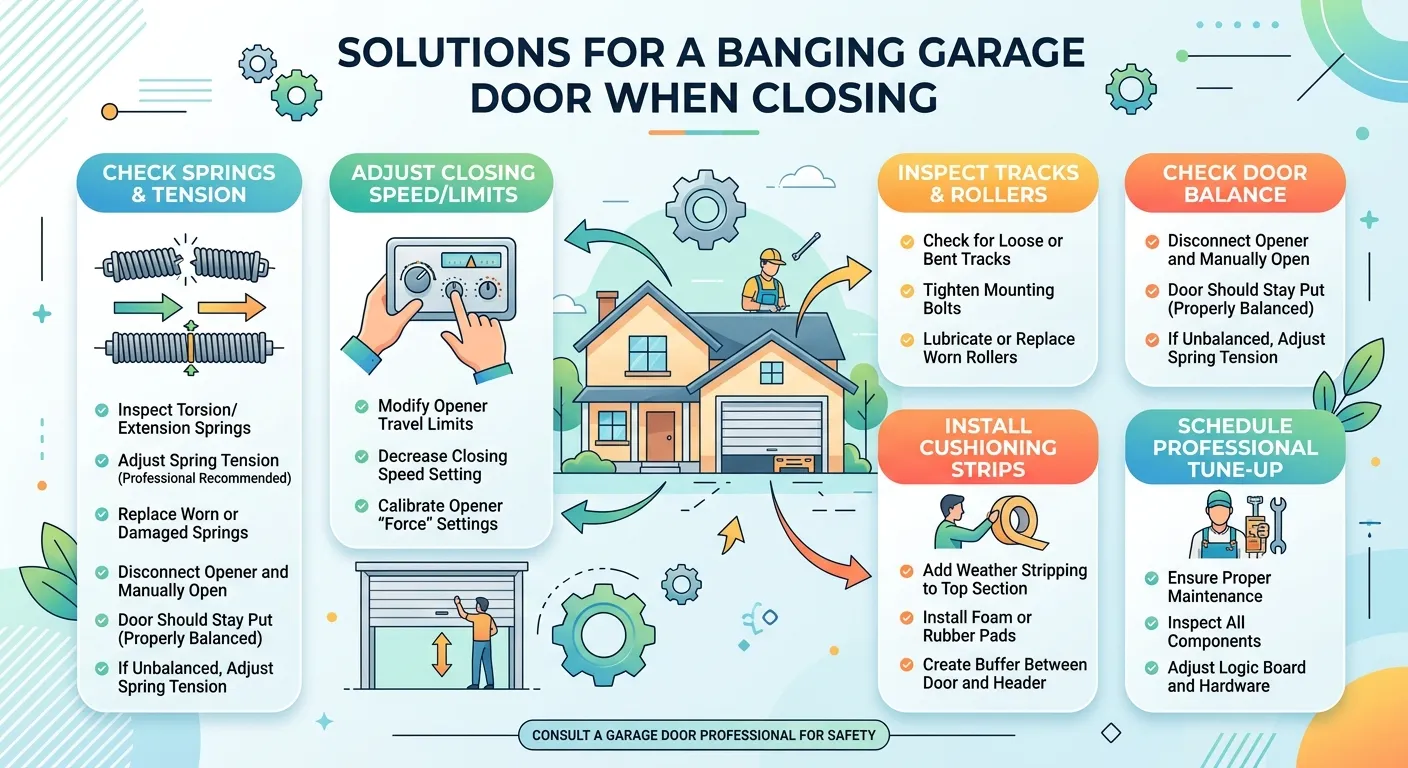
A banging garage door is worth taking more seriously than a squeak or a grind, because a bang is the sound of something giving way rather than just rubbing. The one bang you should never ignore is a single sharp crack that leaves the door stuck, which is almost always a broken spring and a genuine safety hazard. A repeated bang during travel is usually loose hardware, worn rollers, cold weather, or opener settings, and several of those are safe to address yourself. The rule of thumb from the field: anything involving the springs or cables is never a DIY job, and a door that slams shut should be taken out of service until it is checked.
For the full picture of every sound your door can make, see our master guide, Why Is My Garage Door So Noisy? 8 Sounds and What Each One Means. And if the noise is a steady squeal rather than a sudden bang, that is a different fix, covered in Why Does My Garage Door Squeak So Loud? 6 Fixes That Actually Work.
If your garage door is banging, slamming, or made a single loud crack and now will not open, Rockford Door Company can respond fast and get it safe again. Book a same-day inspection or request a free quote and we will tell you exactly what banged and what it takes to fix it.