
A loud, squeaking garage door is almost always dry metal parts rubbing together, and in most homes the fix is simple: clean the tracks and lubricate the rollers, hinges, and bearings with a garage-door-rated spray. If the squeak comes back fast, the rollers are worn and need replacing. The six fixes that actually work, in order of how often they solve the problem, are lubrication, roller replacement, tightening loose hardware, cleaning the tracks, lubricating the springs, and replacing worn hinges or weatherstripping. A dry, straining garage door opener can add its own squeal on top, so listen for whether the sound is at the door or the motor. Never use WD-40, and never touch the springs or bottom brackets yourself. If the door has also become heavy or moves unevenly, that is more than a squeak and needs a technician, and on a very old, worn-out door it can even point toward a garage door replacement rather than another round of repairs.
Key takeaways
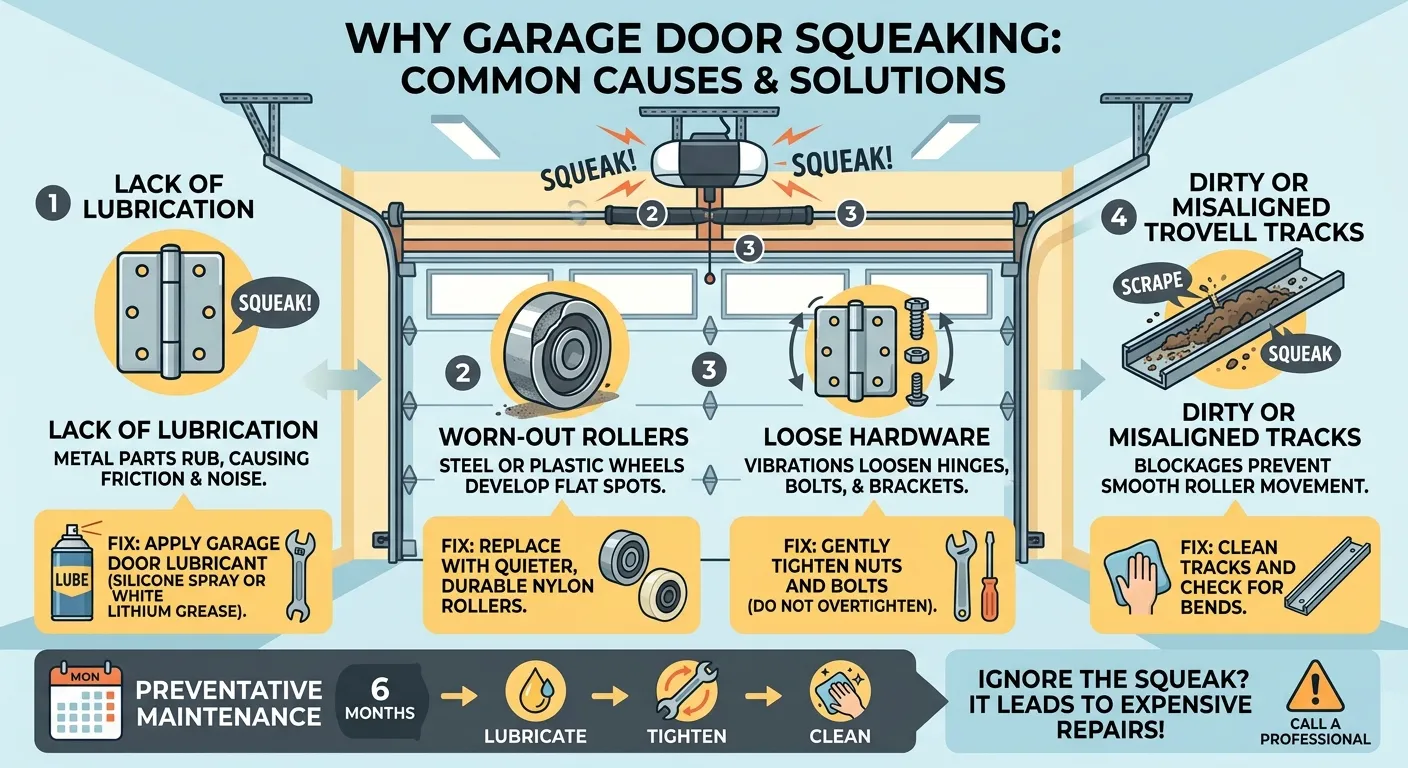
- A loud squeak is dry metal, not a serious fault. Lubrication solves the large majority of squeaky doors.
- Use a garage-door silicone or white lithium spray, never WD-40, which strips lubrication and pulls in grit.
- If lubricating only quiets the squeak for a week or two, the rollers are worn and should be replaced with nylon.
- Loose hardware adds a rattling squeak, and a socket wrench pass fixes it in minutes.
- You can lightly lubricate the springs, but never adjust their tension or touch the bottom brackets.
- If the door squeaks and is also heavy, jerky, or crooked, stop and call a pro. That is a balance or track problem, not a lubrication one.
Fix 1: Lubricate the rollers, hinges, and bearings
What it fixes: The most common cause of a loud squeak, dry moving parts. This single step silences most squeaky doors.
How to do it:
- Close the door and unplug the opener.
- Wipe the tracks clean with a dry cloth. Do not lubricate inside the tracks, only the moving parts.
- Spray a garage-door-rated silicone or white lithium product on each roller, hinge, and bearing plate.
- Open and close the door a few times to spread the lubricant.
Skip WD-40. It is a degreaser and water displacer, not a lubricant, and it strips the protective coating while attracting dust. A dedicated product such as WD-40 Specialist Silicone or a white lithium spray is what you want. Keeping this on a schedule is part of a good annual maintenance routine.
Call a pro if: The squeak returns within a couple of weeks. That points to worn parts, covered in Fix 2.
How to fix a squeaky garage door with lubrication
Lubrication works when the squeak is pure dryness. Hit every roller, hinge, and bearing, run the door a couple of cycles, and the squeal usually disappears. If it comes back quickly, lubrication is only masking worn rollers, and you have moved from a maintenance job to a small repair.
Fix 2: Replace worn rollers
What it fixes: A squeak that keeps returning after lubrication, often with the door wobbling or a gritty edge to the sound. A gritty grind rather than a clean squeal points more toward our companion guide, Why Is My Garage Door Grinding? 5 Causes and How to Fix It.
How to do it:
- With the door closed and opener unplugged, check each roller for flat spots, cracks, wobble, or worn bearings.
- Replace worn steel rollers with nylon rollers, which are quieter and last longer.
- Replace the rollers mounted in the hinges only. The bottom-bracket rollers are under spring tension.
You can see where rollers sit in the system in our anatomy of a garage door overview.
Call a pro if: The worn rollers are the bottom ones held by the bottom brackets, or you are not comfortable releasing rollers from the hinges. Anything connected to the bottom bracket is under spring tension.
How to stop a squeaky garage door by replacing rollers
Worn rollers squeak because the bearing inside them is failing and the wheel no longer rolls smoothly. Swapping them for nylon rollers is the permanent fix, and doing the full set keeps the door traveling evenly. Leave the bottom-bracket rollers to a technician.
Fix 3: Tighten loose hardware
What it fixes: A squeak mixed with a rattle or clatter, caused by nuts and bolts that have vibrated loose over thousands of door cycles.
How to do it:
- Unplug the opener and close the door.
- Go over every visible nut and bolt on the hinges, roller brackets, and track mounts with a socket wrench.
- Snug each one without overtightening, which can strip the hole or crack a hinge.
- Confirm the track mounting brackets are tight to the wall and ceiling.
Call a pro if: The rattle continues after everything is tight, or you find loose bolts on the spring assembly or bottom brackets. Those are under tension and are not safe to adjust.
How to fix a squeaky garage door by tightening bolts
Loose hardware lets parts shift and squeak against each other as the door moves. A ten-minute pass with a socket wrench, snugging every hinge and bracket bolt, removes that source of noise. Stay away from anything attached to the springs or the bottom brackets.
Fix 4: Clean the tracks
What it fixes: A squeak that changes or worsens at one spot in the door’s travel, caused by debris or hardened old grease in the track.
How to do it:
- Close the door and unplug the opener.
- Inspect the full length of both tracks for dirt, caked grease, rust, and small obstructions.
- Wipe the tracks clean with a dry or lightly damp cloth.
- Do not spray lubricant inside the track channel. Lubricate the rollers, not the track.
Call a pro if: You find a dent or bend in the track, or the squeak stays after cleaning. A damaged track needs professional attention.
How to fix a garage door squeaking on the track
Track squeaks are usually just dirt and old grease the rollers are dragging through. A clean cloth along both rails fixes it. Resist the urge to grease the track itself, which only collects more grit. If the track is dented or bent, cleaning will not help and it needs a technician.
Fix 5: Lightly lubricate the springs
What it fixes: A squeak or creak coming from the top of the door where the springs sit, caused by dry coils rubbing as they wind and unwind.
How to do it:
- Close the door and unplug the opener.
- Lightly mist the springs with a garage-door silicone or lithium spray.
- Wipe away any excess.
- Do not loosen, adjust, or reposition anything. Lubricating the surface is safe; touching the tension is not.
Call a pro if: The springs look rusted, gapped, or stretched, or the squeak is paired with the door feeling heavy. That is a spring wear issue, not a lubrication one, and springs are never a DIY repair.
How to quiet squeaky garage door springs safely
You can safely spray the outside of the springs to quiet a dry creak, and that is the only spring maintenance a homeowner should do. Anything involving the tension, the winding cones, or the cables carries serious injury risk and belongs to a technician. If a light lube does not help, the springs are wearing out.
Fix 6: Replace worn hinges or weatherstripping
What it fixes: A persistent squeak that lubrication cannot cure, coming from cracked hinges, or a rubbery squeak along the bottom from dried-out weatherstripping.
How to do it:
- Inspect the hinges for cracks, rust, or excessive play. A worn hinge squeaks even when lubricated.
- Check the bottom weather seal for drying, cracking, or brittleness.
- Cracked hinges and worn seals can be replaced with matching parts.
- Match hinge numbers exactly, since garage door hinges are numbered by position.
Our garage door opener parts guide shows how the hardware fits together.
Call a pro if: Multiple hinges are cracked, the door is sagging, or you are unsure which hinge number goes where. Sagging usually signals a bigger structural or spring issue. Replacing a few hinges is a routine garage door repair, though a door that sags badly is sometimes left over from a poor garage door installation and is worth a professional assessment.
How to fix a squeaky garage door hinge
A hinge that squeaks after lubrication is worn out and needs replacing, not more grease. Match the replacement to the hinge’s stamped number and position. If several hinges are failing at once, have a technician check the door for sagging or a balance problem behind it.
DIY-safe vs. call-a-pro at a glance
Squeak fix | DIY-safe? | What to do |
Lubricate rollers, hinges, bearings | Yes | Garage-door silicone or lithium spray, never WD-40 |
Tighten loose hardware | Yes | Socket-wrench pass on hinges and brackets |
Clean the tracks | Yes | Wipe rails with a dry cloth |
Replace hinge-mounted rollers | Sometimes | Swap to nylon; leave bottom brackets to a pro |
Light spring lubrication | Sometimes | Surface mist only; never touch tension |
Replace cracked hinges | Sometimes | Match hinge number; call a pro if door sags |
Worn bottom-bracket rollers | No | Under spring tension, technician only |
Spring adjustment or replacement | No | Never DIY, serious injury risk |
Squeak plus a heavy or crooked door | No | Balance or track problem, needs a pro |
The bottom line
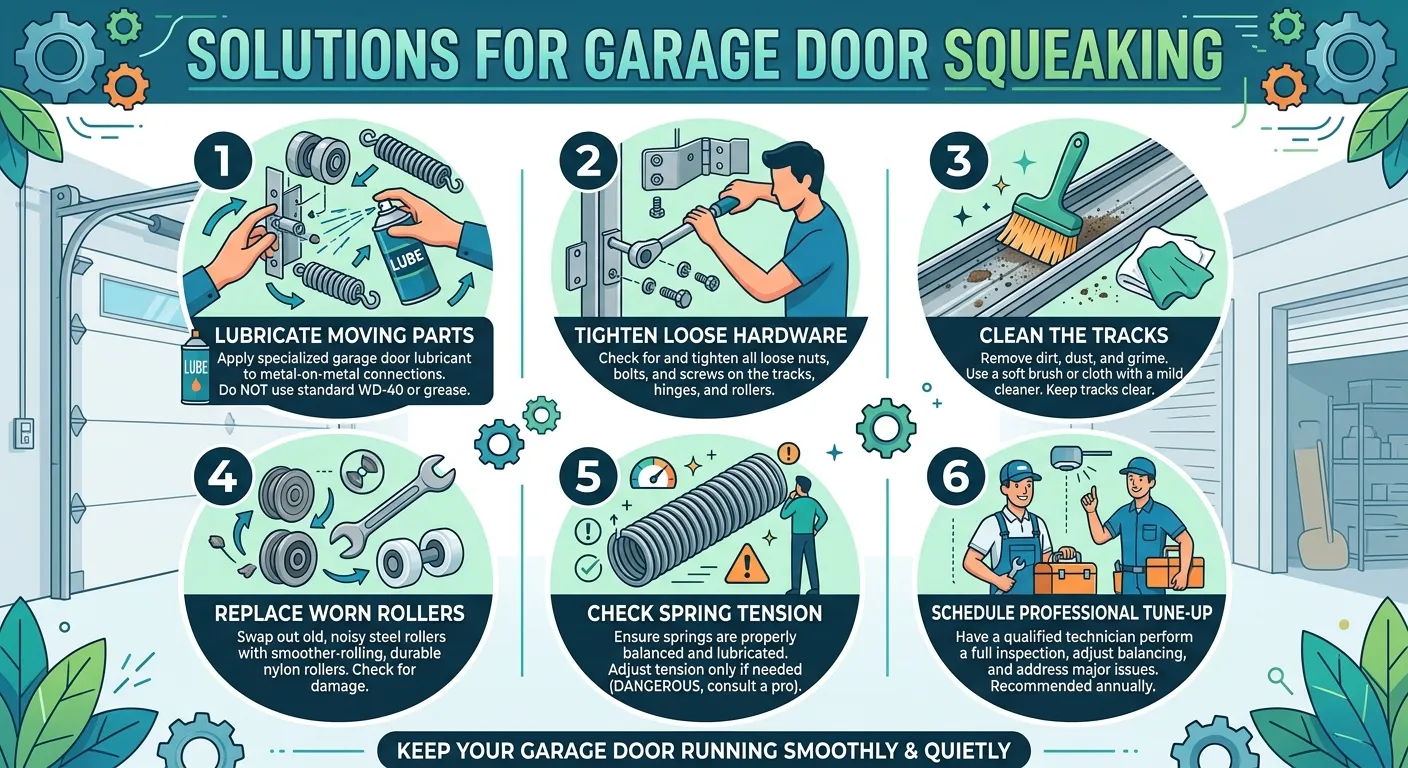
A loud squeak is one of the friendliest problems a garage door can have. Nine times out of ten it is dry metal, and a proper garage-door lubricant on the rollers, hinges, and bearings clears it right up. Tightening loose hardware and cleaning the tracks handle most of the rest. The moment a squeak survives lubrication, points to worn rollers or cracked hinges, or shows up alongside a door that has become heavy or crooked, you have crossed from maintenance into repair. Springs in particular are never a DIY job. When you are not sure which side of that line you are on, the safe move is to stop and have it inspected.
For the full picture of every sound your door can make, see our master guide, Why Is My Garage Door So Noisy? 8 Sounds and What Each One Means. And if what you are hearing is a sudden bang rather than a steady squeak, that is a different problem with different causes, covered in Why Does My Garage Door Bang When It Opens or Closes? 5 Likely Causes.
If your garage door is squeaking loudly and lubrication has not solved it, Rockford Door Company can find the source and fix it fast. Book a same-day inspection or request a free quote and we will have your door running quietly again.