
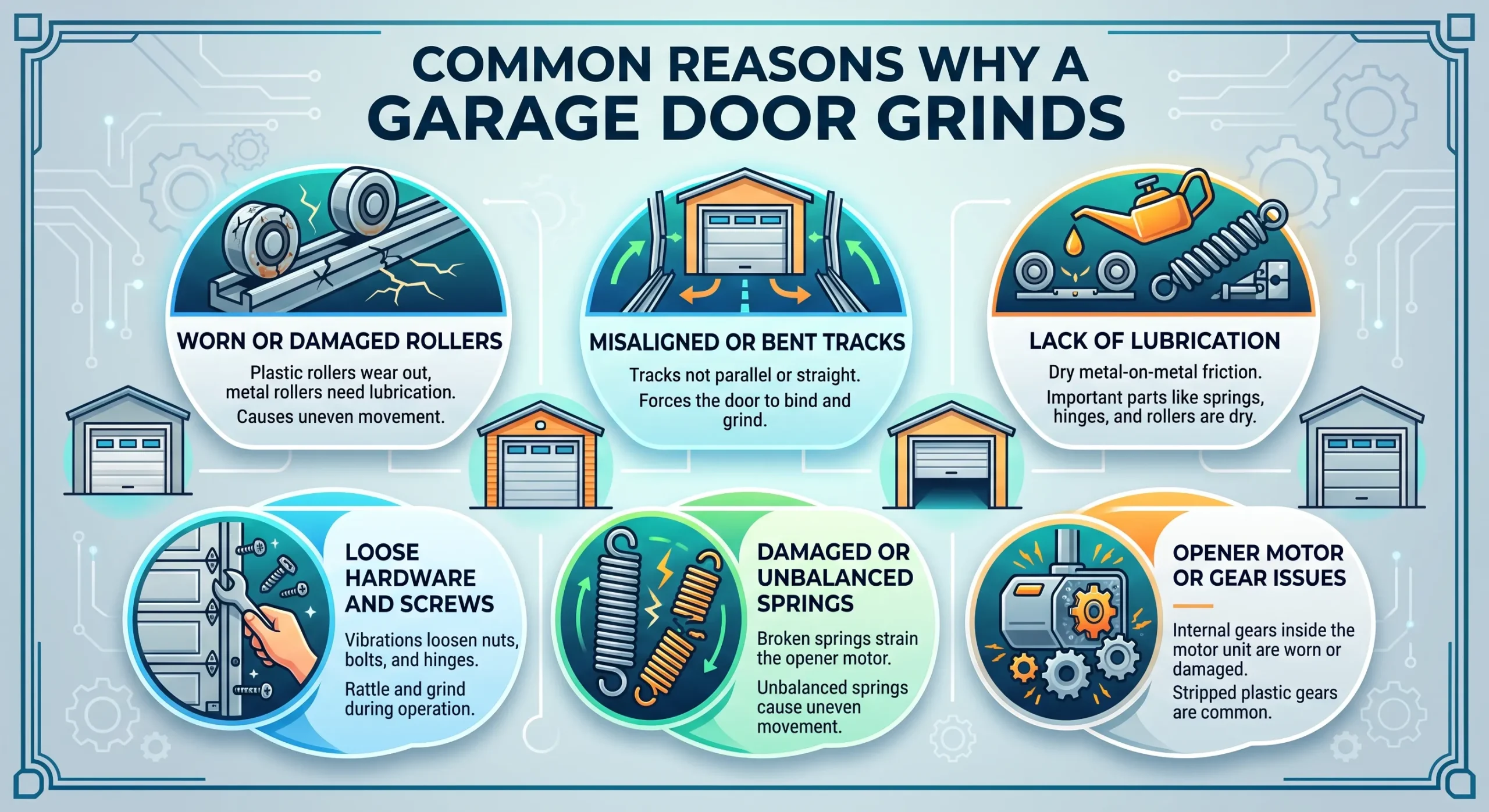
A grinding garage door almost always means two hard surfaces are dragging with no lubrication between them. The five usual causes are dry rollers, worn-out rollers, a dirty or obstructed track, a stripped drive gear inside the garage door opener, or a bent track. Where the grind is loudest tells you which. If it comes from the door as it travels, it is usually rollers or track, and lubrication or roller replacement fixes it. If it comes from the opener unit and the door barely moves, the drive gear is likely stripped and the opener needs service. Never keep running the opener through a grind, and never touch the springs while investigating. Most grinding is a straightforward repair, but if an aging door and a failing opener are grinding together, it may be worth weighing a full garage door replacement.
Key takeaways
- Grinding is a metal-on-metal sound. It means something has lost its lubrication or worn out, not just gone dry.
- Locate the source first. Grinding at the rollers and track is often DIY. Grinding inside the opener usually is not.
- Worn steel rollers are the most common cause. Replacing them with nylon rollers is quieter and longer-lasting.
- Use a garage-door-rated silicone or lithium spray, never WD-40, which strips lubrication and attracts grit.
- A stripped opener gear makes the motor grind while the door barely moves. Stop using it before you burn out the motor.
- Never adjust or touch the springs or cables while chasing a grinding noise. They hold extreme tension.
1. Dry rollers, hinges, and bearings
Symptom: A grinding or grating sound spread along the door’s travel, often worse after months without maintenance or in cold weather.
Most likely cause: Lack of lubrication. This is the most common and most fixable cause of grinding. When rollers, hinges, and bearings run dry, metal grinds on metal at every point of contact.
Fix steps:
- Close the door and unplug the opener.
- Wipe the tracks clean with a dry cloth. Do not lubricate the inside of the tracks, only the moving parts.
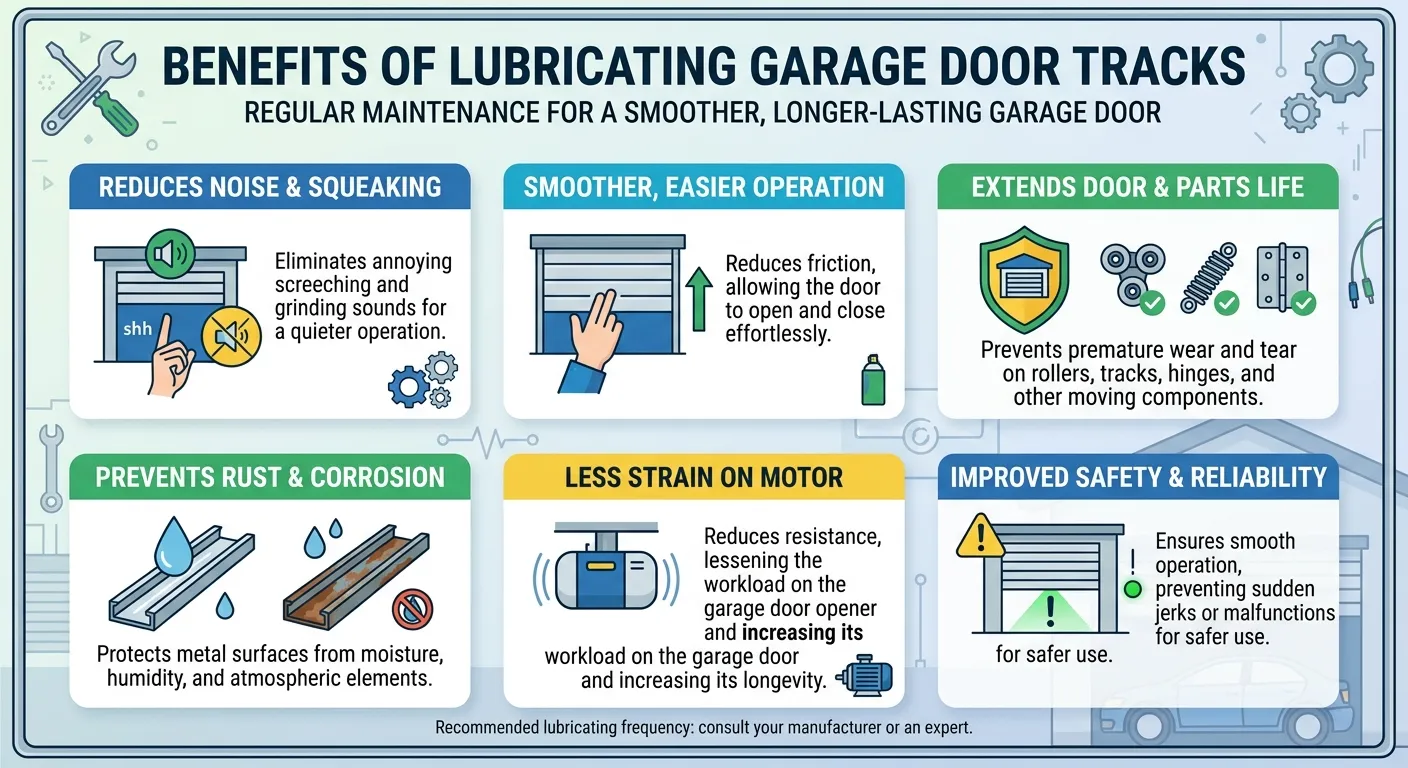
- Apply a garage-door-rated silicone or white lithium spray to the rollers, hinges, and bearing plates.
- Run the door a few cycles by hand or opener to work the lubricant in.
This is exactly the kind of thing a simple annual maintenance routine prevents. Manufacturers such as LiftMaster recommend routine lubrication for the same reason.
Call a pro if: The grinding continues after a thorough lubrication. That means a part is worn rather than just dry.
How to fix a grinding garage door caused by dry parts
If dryness is the culprit, a proper garage-door lubricant on every roller, hinge, and bearing usually clears the grind within a cycle or two. If it comes back within weeks, the parts are worn and lubrication is only masking the problem. A grind that is high-pitched rather than gritty is often a squeak instead, which we cover in Why Does My Garage Door Squeak So Loud? 6 Fixes That Actually Work.
2. Worn-out rollers
Symptom: A gritty, rough grinding that stays even after you lubricate, sometimes with the door wobbling or bumping as it moves.
Most likely cause: Worn or damaged rollers. Steel rollers wear down, develop flat spots, or lose their bearings over years of use, and then they grind through the track instead of rolling smoothly.
Fix steps:
- With the door closed and opener unplugged, inspect each roller for flat spots, cracks, wobble, or missing bearings.
- Confirm the grind traces to the rollers by watching the door travel from a safe distance.
- Rollers that are not attached to the bottom bracket can be replaced. The bottom-bracket rollers are under spring tension and are not safe to touch.
- Replace worn steel rollers with nylon rollers for quieter, longer-lasting travel.
You can see how rollers sit within the system in our anatomy of a garage door overview.
Call a pro if: The worn rollers are the bottom ones held by the bottom brackets, or you are not comfortable releasing rollers from the hinges. This is a common repair but it puts your hands near tensioned parts.
Why are my garage door rollers grinding
Rollers grind when the bearing inside them fails or the wheel flat-spots, so they drag rather than roll. Lubrication buys a little time but the real fix is replacement, ideally with nylon rollers. If several rollers are worn, replace them as a set so the door travels evenly.
3. A dirty or obstructed track
Symptom: Grinding that gets worse at a specific spot in the door’s travel, as if it is catching on something.
Most likely cause: Debris, hardened old grease, or a small dent in the track. The rollers grind as they force past the obstruction at that one point.
Fix steps:
- Close the door and unplug the opener.
- Inspect the full length of both tracks for debris, caked grease, rust, or dents.
- Wipe the tracks clean with a dry or lightly damp cloth. Do not spray lubricant inside the track channel.
- Clear any loose debris. Small buildup you can clean yourself.
Call a pro if: You find a dent or bend in the track, or the grind stays after cleaning. A damaged track needs straightening or replacement, covered in cause 5 below.
How to fix a garage door grinding on the track
Most track grinding is just dirt and old grease that the rollers are forcing through. A clean cloth and a careful inspection solve it. If the track is physically dented or bent, cleaning will not help, and forcing the door through a damaged track can eventually pull it off the rails.
4. A stripped opener drive gear
Symptom: The grinding comes from the opener unit itself, the motor runs or hums, but the door barely moves or does not move at all.
Most likely cause: A stripped drive gear inside the opener. The plastic main gear wears down over years and can no longer transfer the motor’s power to the door. This is one of the most common opener failures we see.
Fix steps:
- Stop pressing the button. Running a stripped opener grinds the remaining teeth and can overheat the motor.
- Pull the emergency release cord and operate the door by hand to confirm the door itself moves freely. If it does, the problem is inside the opener.
- A gear-and-sprocket kit can sometimes be installed, but matching the part and reassembling the drive correctly is a job for a technician.
If the noise is clearly inside the opener, our guide on a garage door opener that stops working walks through the internal causes, and garage door opener parts shows what is inside the unit.
Call a pro if: The grinding is inside the opener. A stripped gear or failing motor needs service, and an aging opener may be more cost-effective to replace. See when to stop using a LiftMaster opener.
Why is my garage door opener grinding but not opening
A grinding opener that will not move the door has almost always stripped its main drive gear. The tell is simple: release the door and lift it by hand. If the door moves freely, the door is fine and the opener’s internals have failed. Continuing to run it only destroys what teeth are left, so stop and get it serviced.
5. A bent or misaligned track
Symptom: Grinding paired with the door looking crooked, traveling unevenly, or a gap that changes as it moves.
Most likely cause: A bent, dented, or shifted track. When the rails are no longer straight and parallel, the rollers grind against the sides of the track instead of gliding down the center.
Fix steps:
- Close the door and look at both tracks from the side. They should be straight and evenly spaced from the door.
- Check that the mounting brackets holding the track to the wall and ceiling are tight and have not shifted.
- Minor loose brackets you can snug with a socket wrench.
- Do not try to bend a track back into shape yourself. Uneven pressure makes alignment worse and can let the door leave the track.
Call a pro if: The track is visibly bent or the door is out of alignment. This is not a safe DIY fix, and a misaligned door can come off its track entirely. A bent track is a common garage door repair, and if the rail was damaged during a previous garage door installation, correcting it properly matters. Our Rockford repair steps show what a professional visit involves.
How to fix a garage door grinding from a bent track
Track alignment is one of the few grinding causes that is almost never a DIY fix. Straightening a rail takes the door being released from tension and the track re-set to spec. Attempting it by hand usually bends the rail further. If cleaning and lubrication did not solve the grind and the door looks crooked, the track is the reason and it needs a technician.
DIY-safe vs. call-a-pro at a glance
|
Grinding cause |
DIY-safe? |
What to do |
|
Dry rollers, hinges, bearings |
Yes |
Lubricate with garage-door silicone or lithium spray |
|
Dirty track (debris, old grease) |
Yes |
Clean the track with a dry cloth |
|
Worn hinge-mounted rollers |
Sometimes |
Replace with nylon rollers; leave bottom brackets to a pro |
|
Loose track brackets |
Sometimes |
Snug the mounting bolts; do not force alignment |
|
Worn bottom-bracket rollers |
No |
Under spring tension, technician only |
|
Stripped opener drive gear |
No |
Stop using the opener, needs service |
|
Bent or misaligned track |
No |
Alignment and track repair are pro jobs |
The bottom line
A grinding garage door is almost always telling you a part has lost its lubrication or worn out. Start by finding where the grind is loudest. If it is along the door’s travel, cleaning the track and lubricating or replacing the rollers usually solves it, and that is safe DIY work. If the grind is inside the opener or the door is running crooked, stop using it, because a stripped gear or a bent track only gets worse and can put the door off its rails. When in doubt, the safe move is to stop and have it inspected before a small repair turns into a big one.
For the full picture of every sound your door can make, see our master guide, Why Is My Garage Door So Noisy? 8 Sounds and What Each One Means. And if the noise you are hearing is a sudden bang rather than a steady grind, that points to a different cause, covered in Why Does My Garage Door Bang When It Opens or Closes? 5 Likely Causes.
If your garage door is grinding and you cannot pin down the cause, or the noise is coming from the opener, Rockford Door Company can diagnose and fix it fast. Book a same-day inspection or request a free quote and we will tell you exactly what is grinding and what it takes to stop it.