
Garage door repairs fall into a predictable order of cost, and knowing that order is more useful than memorizing any single number. Sensor alignment and roller work sit at the low end. Cable and spring replacement sit in the middle. A full opener replacement is the most expensive item on this list. What separates a fair quote from an inflated one is not the total, it is whether the price matches the actual work: which parts failed, what grade of replacement is going in, and how much skilled labor the job genuinely takes. Learn the drivers and you can evaluate any quote you are handed.
Key takeaways
- Labor is usually the larger half of a garage door repair bill, not parts.
- Spring replacement is the most common repair and the most common vehicle for overcharging.
- An unusually cheap advertised price is a warning sign, not a bargain.
- Doing both springs at once costs more today and less over the life of the door.
- Age of the opener, not the specific fault, usually decides repair versus replace.
- Compare the spec on competing quotes, not just the total. Two spring quotes can differ by years of service life.
Knowing what drives these prices is the practical defense against being overcharged. Clopay’s guide to avoiding garage door repair scams names this directly: these operations depend on homeowners having no idea what parts and service actually involve. Ten minutes of reading removes that advantage.
Here are the seven repairs that cover the large majority of residential calls, ordered by how often they come up.
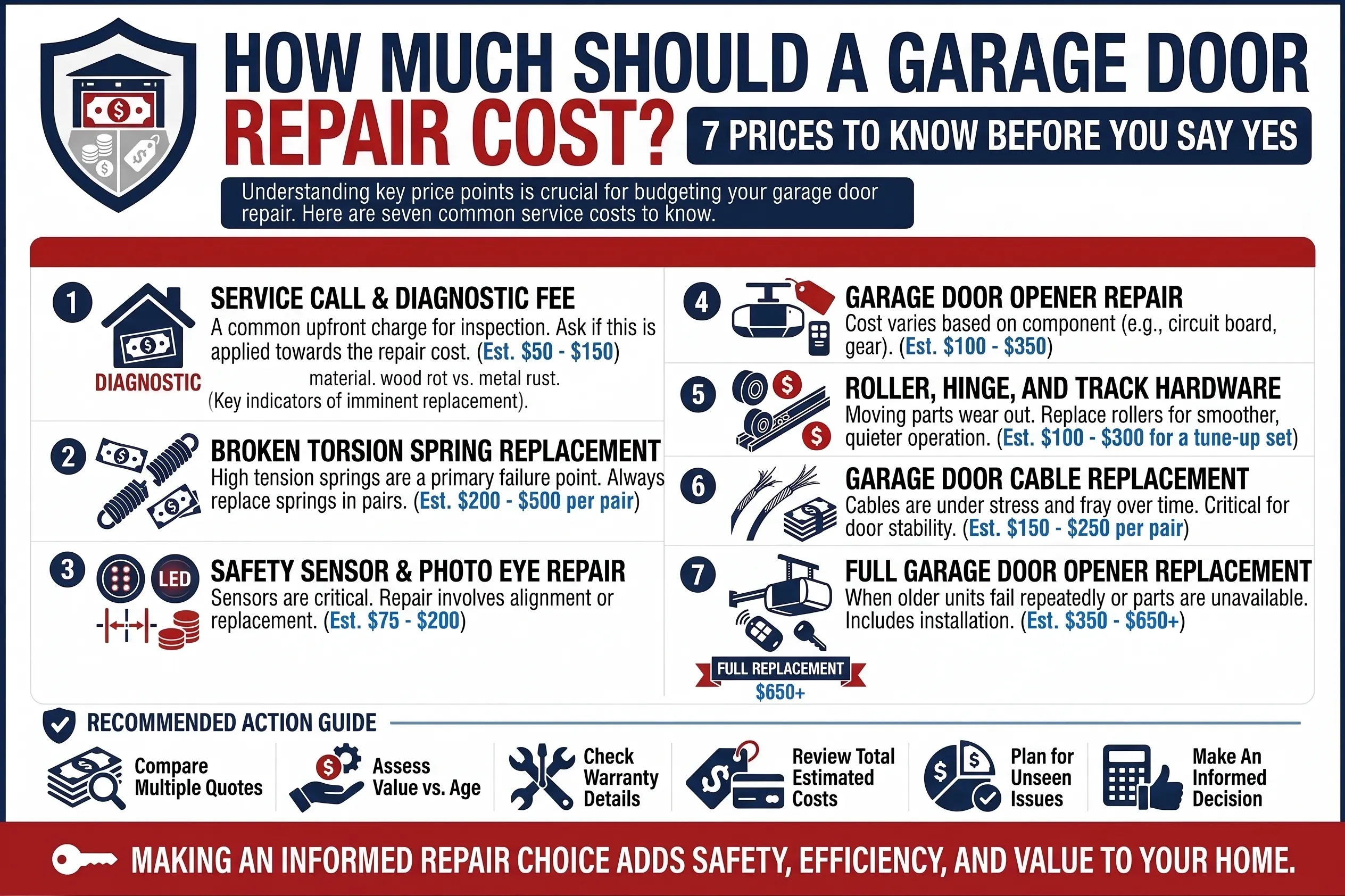
1. The service call or diagnostic fee
Where it sits: the smallest line on any invoice, and the only one you may pay without work being done.
What it is: The flat charge for sending a licensed technician to your property, inspecting the full system, and diagnosing the fault. Almost every company charges one, and a company claiming to charge nothing at all is usually recovering it inside an inflated repair price.
What drives it: Distance from the shop, time of day, and whether the visit is scheduled or an emergency. A Saturday afternoon call in Rochelle costs more to staff than a Tuesday morning call in Loves Park.
What it should include: A full inspection of tracks, rollers, hinges, cables, springs, and the opener, plus a spoken and written explanation of what was found.
What a garage door service call fee should cover
Ask two questions when you book: how much is the fee, and does it apply toward the repair if you go ahead. Many companies credit it. Some do not. Both are legitimate, but you should know which before the truck arrives. Learning this on the invoice instead of on the phone is a classic setup, and it is one of the tactics covered in Why Was My Garage Door Repair Bill Higher Than the Quote? 6 Tactics to Watch For.
2. Broken torsion spring replacement
Where it sits: mid-range for one spring, and the most common repair bill homeowners see.
What it is: The single most common garage door repair there is. Torsion springs counterbalance the weight of the door, they are consumable parts rated in cycles, and they fail on a schedule whether you maintain them or not.
What drives it: Door weight and height, spring cycle rating, and whether the system uses one spring or two. A high-cycle spring costs more upfront and lasts substantially longer, which is usually the better value on a door used several times a day.
What it should include: New spring or springs, hardware, balance adjustment, and a full safety test of the door after installation.
Why garage door spring replacement costs what it does
Most of the cost is labor and risk, not the steel. Torsion springs store enough energy to cause serious injury or death, and winding them requires proper bars and technique. This is never a DIY repair. Do not attempt it, and do not buy a spring online to save money on parts.
The cycle rating is where quotes legitimately diverge, and it is worth understanding the different types of springs and their benefits for garage door systems before you compare two numbers. A cheaper quote using a lower-cycle spring is not actually cheaper over five years. If you are not certain the spring is what failed, you can check the signs of a broken spring yourself from a safe distance without touching the door.
3. Safety sensor and photo eye repair
Where it sits: among the least expensive repairs on this list, and the one most often inflated.
What it is: The two small units near the floor on either side of the opening. When they are dirty, knocked out of alignment, or wired loose, the door refuses to close and the opener light usually blinks.
What drives it: Whether the sensors need cleaning and realignment, which is minor, or full replacement including wiring, which is not.
What it should include: Alignment, cleaning, wiring check, and a reversal test with an obstruction.
Why garage door sensor repair should be one of the cheapest fixes
A homeowner facing a door that will not close cannot tell whether the problem is a five-minute alignment or a failed logic board, and that gap is exactly what gets exploited. If a technician quotes a large number for sensors, ask to watch the alignment attempt first. Very often the fix is simple, and there are several other common reasons a garage door will not close that cost nothing to rule out.
4. Garage door opener repair
Where it sits: the widest spread on this list. A limit switch and a control board are not remotely the same bill.
What it is: Repair of the motor unit itself: circuit boards, gear and sprocket assemblies, capacitors, limit switches, travel modules, and remote receivers.
What drives it: Which component failed and whether the part is still manufactured for that model. A gear and sprocket kit on a common LiftMaster is routine. A board for a discontinued unit may not be available at any price.
What it should include: The replacement component, labor, recalibration of force and travel limits, and a safety reversal test.
How to tell if a garage door opener repair is worth the cost
The rule most technicians work by: if the repair approaches roughly half the cost of a new unit and the opener is past ten years old, replacement is usually the better spend. Under that threshold, repair almost always wins. Knowing the parts inside a garage door opener makes it much harder to be sold a whole unit when a single component failed, and a straightforward garage door opener repair resolves a large share of these calls.
5. Roller, hinge, and track hardware
Where it sits: low to moderate, and priced as a set rather than per part.
What it is: The rolling and pivoting hardware that lets the door travel the track. Worn rollers are the usual cause of a door that has become loud, rough, or shaky.
What drives it: Roller type and door size. Steel rollers are cheapest and loudest. Nylon rollers with sealed bearings cost more and run considerably quieter. A standard door has ten to twelve rollers, and they are replaced as a set.
What it should include: All rollers, any damaged hinges, track alignment, and lubrication of the full system.
How much it costs to replace garage door rollers and hinges
This is one of the few repairs where paying more genuinely buys a better daily experience, because the noise difference between steel and nylon is immediately obvious in an attached garage. It is also the repair most often prevented outright by maintenance, which is worth weighing when you look at the garage door maintenance checklist and whether to DIY or hire a pro.
6. Garage door cable replacement
Where it sits: mid-range, comparable to spring work, and usually quoted for both sides.
What it is: The steel lift cables running from the bottom brackets to the drums. They fray over time and can snap, which typically leaves the door hanging crooked with one side higher than the other.
What drives it: Whether one or both cables are replaced, and whether the drums need re-seating and the door re-balancing afterward.
What it should include: New cables, drum re-seating, and full balance adjustment.
Why garage door cable replacement is usually done in pairs
Cables wear at the same rate on both sides, so replacing one and leaving the other typically means a second service call within a year. A quote covering both is not padding, it is standard practice.
Safety note: A door with a snapped cable is unbalanced and unsafe. Do not run the opener and do not try to lift it by hand. Leave it in place and call a technician. Cable work sits alongside springs in the category of garage door repair that carries real injury risk for an untrained person.
7. Full garage door opener replacement
Where it sits: the most expensive item on this list, and the one with the widest range of options.
What it is: Removing the existing unit and installing a new opener, rail, and safety sensors, then programming remotes and keypads.
What drives it: Drive type and horsepower. Chain drive is the least expensive. Belt drive costs more and runs much quieter. Wall-mount jackshaft units cost the most and free up ceiling space. Smart features, battery backup, and integrated cameras add to the total.
What it should include: The unit, rail, new safety sensors, mounting hardware, removal and disposal of the old opener, remote and keypad programming, and a full safety test.
When replacing a garage door opener costs less than repairing it
Sizing is the part homeowners most often get wrong, and an undersized unit fails early on a heavy door, which turns a one-time cost into a recurring one. Before comparing quotes, work out what size garage door opener you actually need for your door weight and material. If you are weighing a replacement, the full range of garage door opener options is worth reviewing before you commit to a drive type.
The seven repairs at a glance
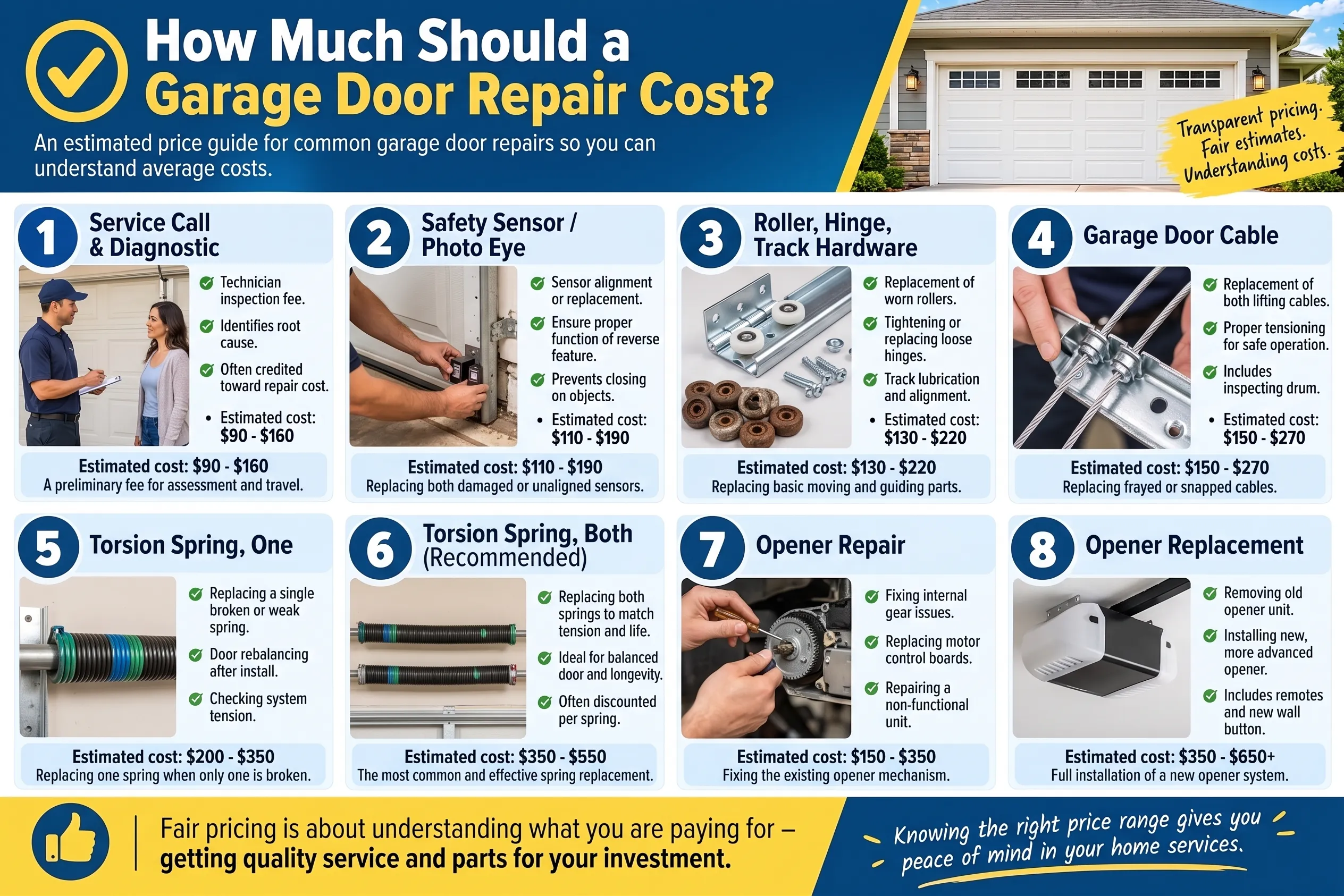
Repair | Where it sits | Main cost driver | The question to ask |
Service call / diagnostic | Smallest line on the invoice | Distance, time of day, emergency status | Is this credited toward the repair? |
Safety sensor / photo eye | Among the cheapest | Alignment only vs. full replacement and wiring | Can you try realigning them first? |
Roller, hinge, track hardware | Low to moderate | Steel vs. nylon rollers, door size | Which roller type is in this quote? |
Garage door cable | Mid-range | One cable vs. both, re-balancing required | Are both cables included? |
Torsion spring, one | Mid-range | Door weight, cycle rating | What is the cycle rating? |
Torsion spring, both | Mid to high | Same, doubled, better long-term value | What does the second spring add? |
Opener repair | Widest spread of any item | Which component failed, part availability | Which part failed, and can I see it? |
Opener replacement | Highest | Chain vs. belt vs. wall-mount, smart features | Is this sized for my door weight? |
A quote you can trace back to a specific failed part and a named component grade is a quote you can evaluate. A number with no breakdown behind it is not, regardless of whether it sounds high or low. An unusually cheap price advertised before anyone has looked at your door is the pattern the International Door Association’s scam awareness resources have been tracking in news coverage across the country, including reporting on schemes that have targeted Illinois homeowners.
Before you approve a quote
Get the number in writing with parts and labor itemized separately. Ask what the warranty covers and for how long. Ask to see the failed component before it is replaced. If any of those requests meets resistance, that resistance is the answer.
Price is only half the picture. When and how you are asked to pay matters just as much, and the full set of warning signs is laid out in Should I Pay a Garage Door Company Before They Do the Work? 8 Red Flags to Watch For. Note that a new door is a different transaction from a repair, and a deposit there is normal industry practice: Is a Deposit Normal for a New Garage Door? 6 Times Paying Upfront Is Fine covers where that line sits. The International Door Association’s industry alert on LinkedIn is another place the trade has been flagging these operations publicly.
The cheapest repair is the one you never need. Rollers, cables, and springs all last longer on a door that gets serviced, which is the practical argument for annual garage door maintenance. If you are replacing rather than repairing, a professional garage door installation is priced on a different basis entirely, closer to a project quote than a service call.
Rockford Door Company is a licensed and insured local company at 1016 23rd St in Rockford, serving Rockford, Loves Park, Machesney Park, Belvidere, Roscoe, Rockton, Cherry Valley, South Beloit, and Beloit, WI. Every job starts with an on-site inspection and a plain-language walkthrough of what we found and what your options are, before any work begins.
Want a real number for your specific door? Schedule service with Rockford Door Company or call 1-815-397-5903. Most repairs can be completed the same day you call.