
A garage door repair bill usually exceeds the quote for one of two reasons. Either the technician found something real that a phone estimate could not have caught, or the low quote was never meant to be the final price in the first place. The way to tell them apart is simple: a legitimate increase comes with a failed part you can see and hold. If nobody can show you what broke, the increase is a sales tactic. Below are the six ways the gap between quote and invoice gets manufactured, and what to say at the moment each one appears.
Key takeaways
- A phone quote is a guess. A modest revision after inspection is normal, and a multiplied total is not.
- Ask to see the failed part before it is replaced. Reluctance to show you is the strongest single signal there is.
- Springs are the most common vehicle for an unnecessary upsell, because homeowners cannot easily verify the diagnosis.
- Get the revised number in writing before work resumes, not after it finishes.
- You are allowed to stop a job mid-visit. Paying the service call fee and sending someone away is always cheaper than an inflated repair.
- “While I’m up here” additions are still charges, and they still need your approval.
Understanding these tactics is the whole defense. Clopay’s guide to avoiding garage door repair scams makes the point directly: these operations rely on homeowners not knowing what the work actually involves. Here are the six patterns, ordered by how often they show up.
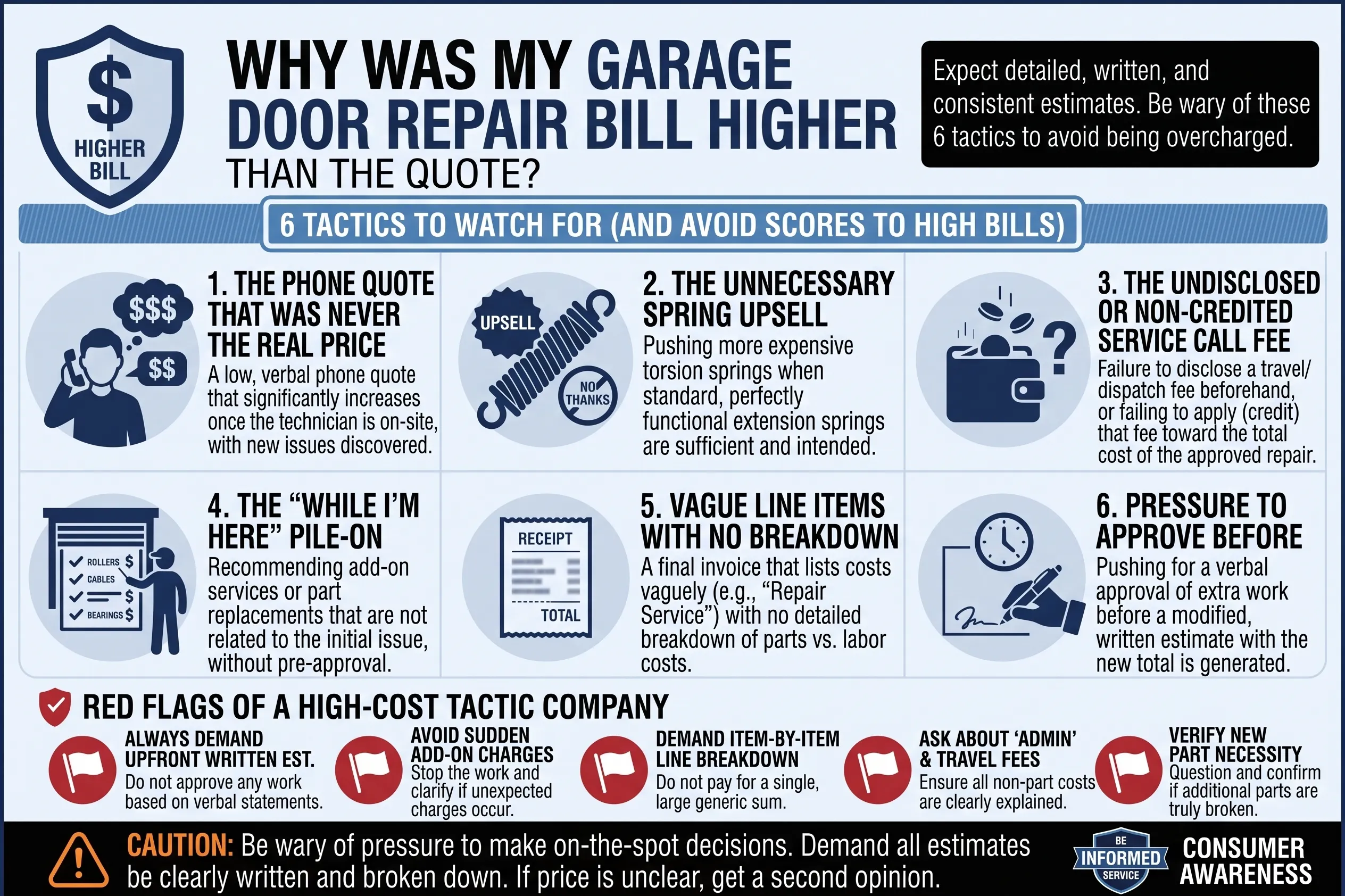
1. The phone quote that was never the real price
How it works: You call, describe the symptom, and get a number that sounds reasonable. The quote exists to win the appointment, not to describe the job. Once a technician is standing in your garage, the real pricing conversation begins.
How to tell it apart from a legitimate revision: Ask what the original quote was based on. A technician who says “that number assumed a standard spring on a single door, and yours is a heavier insulated door with two springs” is describing something real. A technician who cannot connect the original number to anything specific never had a basis for it.
What to say: “Walk me through what changed from the number I was given on the phone.”
Why a garage door repair quote goes up after the technician arrives
Some increases are honest. A door can have a snapped cable, a bent track, and worn rollers on top of the spring you called about, and none of that is visible over the phone. The difference is whether each addition comes with a physical failure you were shown. Broad symptoms like a door that will not close all the way genuinely can have several unrelated causes, which is exactly why an on-site look sometimes changes the number.
2. The unnecessary spring upsell
How it works: Springs are the most profitable overcharge in the trade because they are the hardest component for a homeowner to assess. A technician can declare a spring failing, or claim both need replacing when neither does, and most people have no way to argue.
How to tell it apart: A broken torsion spring is unmistakable. The coil shows a clear separation, usually a visible gap of an inch or two. Ask the technician to point at it. If the claim is that a spring is “about to go” rather than broken, ask what specifically indicates that: rust, coil spacing, cycle age, or a measured imbalance.
What to say: “Show me the break, or show me what tells you it is failing.”
How to verify a garage door spring actually needs replacing
You can check this yourself from a safe distance without touching anything. Look at the springs above the door and see whether the coil is continuous or separated. Understanding the causes and risks of a broken garage door spring makes the conversation much more even.
Safety note: Looking is fine. Touching is not. Torsion springs store enough energy to cause serious injury or death, and adjusting or replacing them is never a DIY job. If a spring is genuinely broken, do not run the opener and do not try to lift the door by hand. A broken garage door spring repair is legitimate skilled work and worth paying a real company to do properly.
3. The undisclosed or non-credited service call fee
How it works: The fee was never mentioned when you booked, or you assumed it would be applied toward the repair and it was not. Either way it lands on the invoice as a surprise line.
How to tell it apart: This one is decided before anyone arrives. A company that discloses the fee on the phone and tells you whether it is credited is being straight with you. A company that goes quiet when asked is not.
What to say, when booking: “What is the service call fee, and does it apply toward the repair if I go ahead?”
Why an undisclosed garage door service call fee is a warning sign
Charging a diagnostic fee is completely normal. Hiding it is not. The fee itself tells you nothing, and how it was communicated tells you everything. Where that fee sits relative to the rest of a repair bill is covered in How Much Should a Garage Door Repair Cost? 7 Prices to Know Before You Say Yes.
4. The “while I’m here” pile-on
How it works: The original job is done, and then come the additions. New rollers. New hinges. A new bottom seal. Lubrication service. Each one sounds minor and each one is presented as convenience rather than a decision, and together they can exceed the repair you actually called about.
How to tell it apart: Recommendations are fine and often genuinely useful. Charges are different. The test is whether you were asked before the part went on, or informed after.
What to say: “Give me the revised total in writing before you start any of that.”
How to stop garage door repair add-ons before they hit the invoice
Some add-ons are worth taking. If a technician is already there and your rollers are visibly shot, replacing them in the same visit saves a future service call. That is a real recommendation, and a door that has become loud is a reasonable reason to consider it. But there is a difference between a suggestion and an assumption, and several other things cause a noisy garage door besides worn rollers, so a diagnosis should come before a part does.
5. Vague line items with no breakdown
How it works: The invoice reads “parts,” “hardware,” “labor,” or “misc” with a total beside each and nothing else. There is no way to tell what was installed or how long anything took, which means there is no way to question it.
How to tell it apart: A real invoice names components. Spring cycle rating. Roller type. Opener part number. Labor hours. Vagueness on an invoice is almost never accidental, because the technician knows exactly what they installed.
What to say: “Itemize this. What part, what spec, and how many hours.”
Why an itemized garage door repair invoice matters
Without the spec, you cannot compare quotes, you cannot enforce a warranty, and you cannot tell whether the part that failed in a year was the right part to begin with. If the work involved the opener, the invoice should name the component, because a garage door opener repair can mean anything from a limit switch to a control board, and those are not comparable jobs. Common faults like an opener that clicks but will not open the door have several possible causes, and the invoice should say which one you paid to fix.
6. Pressure to approve before the number is in writing
How it works: The technician is mid-job, the door is disassembled, and you are asked to approve additional work verbally so they can keep moving. The written total arrives afterward, and by then the parts are installed.
How to tell it apart: Urgency framed around convenience is still urgency. A genuine safety issue can be explained in one sentence and does not require you to skip the paperwork.
What to say: “Stop here. Put the new total in writing and I will approve it or I will not.”
Why you should never approve garage door repair work verbally
A disassembled door feels like a point of no return, and that feeling is what gets exploited. It is not one. You can pay for the diagnostic time and stop the job. The International Door Association’s scam awareness resources track news coverage of operations built entirely on this moment, including reporting on schemes that have targeted Illinois homeowners. When you are choosing who to call in the first place, the payment-side warning signs are laid out in Should I Pay a Garage Door Company Before They Do the Work? 8 Red Flags to Watch For.
Legitimate increase vs. bait and switch
Signal | Legitimate increase | Bait and switch |
The failed part | Shown to you, explained, available to keep | Not shown, or removed from the property |
Scale of the change | Modest revision on a specific finding | Total multiplies well beyond the original |
Timing of approval | Written revised total before work resumes | Verbal approval mid-job, paperwork after |
Invoice detail | Named components, specs, labor hours | “Parts,” “hardware,” “labor,” “misc” |
Explanation | Traces clearly back to the original quote | Cannot say what the first number was based on |
Response to questions | Slows down and walks you through it | Presses on urgency or convenience |
Second opinion | Welcomed, no pressure | Discouraged or treated as an insult |
Warranty | Written on the invoice with duration and coverage | Promised out loud, appears nowhere |
The pattern matters more than any single row. One item on the right side might be a bad day. Three or four is a business model, and Clopay’s guide notes these operations often have no verifiable physical location behind the phone number at all.
What to do if the bill is already higher than you agreed
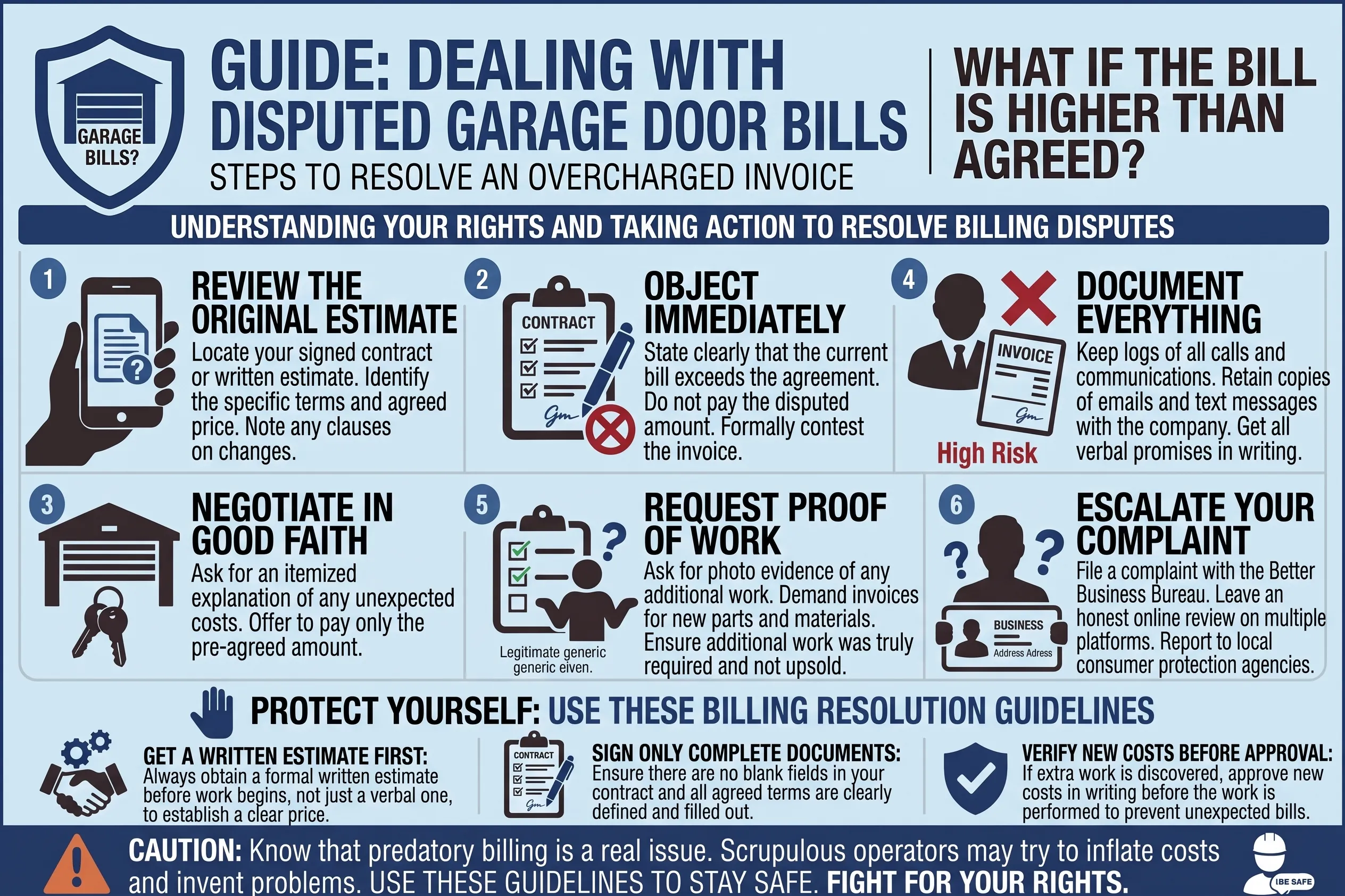
Ask for the itemized breakdown before you pay. Ask to see any part that was replaced. If the explanation does not hold up, say you will pay the amount you originally agreed to and dispute the rest, then put that in writing by email the same day so there is a record.
If you paid by card, contact your issuer promptly, because dispute windows are limited. Report the company to the Better Business Bureau and your state consumer protection office. The International Door Association’s industry alert on LinkedIn is another place the trade has been publicly flagging these operations.
Prevention is far easier than recovery. Vetting a company before an emergency means you are not choosing one at nine at night with a door stuck open, and the standards worth applying to any garage door repair company are written down in our guide to emergency garage door repair and family safety in Rockford. Note that new doors work differently: a deposit there is normal industry practice, which is covered in Is a Deposit Normal for a New Garage Door? 6 Times Paying Upfront Is Fine, and a professional garage door installation is quoted as a project rather than a service call. The same goes for a full garage door opener replacement, which should be quoted with the model named before anyone starts.
A door on a service schedule also fails less dramatically, which is the practical argument for regular garage door maintenance. Fewer emergencies means fewer rushed decisions in the driveway.
Rockford Door Company is a licensed and insured local company at 1016 23rd St in Rockford, serving Rockford, Loves Park, Machesney Park, Belvidere, Roscoe, Rockton, Cherry Valley, South Beloit, and Beloit, WI. Every job starts with an on-site inspection and a plain-language walkthrough of what we found and what your options are, before any work begins.
Want a number you can hold us to? Schedule service with Rockford Door Company or call 1-815-397-5903. Most repairs can be completed the same day you call.