
Yes. A deposit on a new garage door is standard practice across the industry, and refusing to pay one will simply mean no company will order your door. The reason is straightforward: a garage door is built to your opening, in your color, with your panel style and glass, and it cannot be resold to anyone else if the job falls through. That is completely different from a repair, where the parts come off the truck and no deposit should be required at all. What makes a deposit legitimate is not its size. It is whether it is tied to a signed order that names the exact door, the timeline, and what happens if either side cancels.
Key takeaways
- Deposits are normal for new doors and abnormal for repairs. The distinction is whether something is being manufactured for you.
- A legitimate deposit comes with a written order specifying model, size, color, glass, hardware, and lead time.
- The balance should be due on completion, after the door is installed and you have watched it cycle.
- Pay a deposit by credit card whenever possible, because it is the only method with real dispute rights.
- A deposit collected before anyone has measured your opening is premature at best.
- No legitimate company asks for the full amount before the door is ordered.
Here are the six situations where paying something upfront is normal business, followed by the terms that separate a real deposit from a bad one.
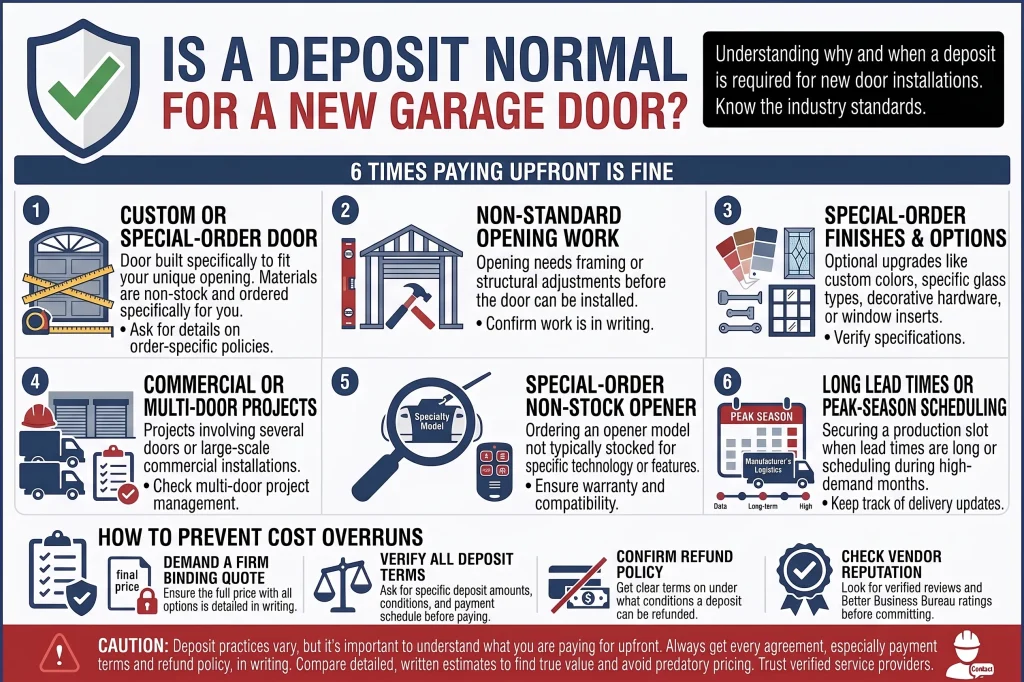
1. A custom or special-order door built to your opening
Why a deposit applies here: The manufacturer cuts steel to your measurements. If you cancel after production starts, that door fits your garage and nobody else’s. The deposit covers the company’s exposure on a product it cannot put back on the shelf.
What the deposit should be tied to: A signed order listing the manufacturer, series, exact width and height, panel style, and finish. Not a verbal agreement and not a total scribbled on a business card.
What is still not okay: Collecting the deposit before anyone has physically measured the opening. Measurements taken from a phone conversation are how doors arrive that do not fit.
Why a custom garage door order requires a deposit
This is the single most common legitimate reason you will be asked for money upfront, and it applies to most doors that are not a plain white standard-size panel. Before you sign anything, it is worth reading what to know before installing a garage door so the order sheet actually reflects what you want. A professional garage door installation is quoted as a project with a lead time, not as a same-day service call, and the payment structure follows from that.
2. A non-standard opening that needs framing or structural work
Why a deposit applies here: Widening an opening, replacing rotted jambs, adding headroom for a different track configuration, or pulling a permit all involve costs the company incurs before your door arrives. Materials get bought and labor gets scheduled in advance.
What the deposit should be tied to: A written scope of the structural work, separate from the door itself, so you can see what portion of the money covers carpentry versus the door.
What is still not okay: A vague “site prep” charge with no description of what will actually be done to your garage.
How structural work changes a garage door deposit
Openings that are out of square, headers that have shifted, and floors that have settled all turn a simple swap into a construction job. Knowing what to check before garage door installation begins helps you tell whether extra work is genuinely needed or is being added to inflate the order. If you are not sure the job requires a professional at all, the signs you need professional garage door installation are a reasonable starting point.
3. Special-order colors, glass, hardware, or window inserts
Why a deposit applies here: Non-stock finishes and glass are ordered per job. A factory-applied woodgrain finish, a specific frosted or tinted glass, or decorative hardware in a particular style all get made or sourced against your order specifically.
What the deposit should be tied to: The finish name or code, the glass type, and the hardware model written on the order. “Dark brown” is not a spec. A manufacturer’s finish name is.
What is still not okay: Being told upgrades are included, then finding them itemized as extras on the final invoice. That is a different problem entirely, and it is covered in Why Was My Garage Door Repair Bill Higher Than the Quote? 6 Tactics to Watch For.
Why special-order finishes and glass carry a deposit
Material choice drives both the lead time and the deposit, so it is worth settling before you order rather than after. The tradeoffs between wood and steel garage doors affect cost, maintenance, and how the door handles Rockford winters. If you are considering glazing, the advantages of glass garage doors explain what you gain and what you give up on insulation.
4. Commercial or multi-door projects
Why a deposit applies here: Commercial work involves heavier doors, longer lead times, and often several openings at once. The company is committing crew time and floating a much larger materials cost, sometimes across weeks.
What the deposit should be tied to: A phased payment schedule written into the contract: a deposit at order, sometimes a progress payment at delivery, and the balance on completion and sign-off.
What is still not okay: A single large payment upfront with no milestones. On a project of any size, payments should attach to things that have visibly happened.
How deposits work on commercial garage door projects
Rolling steel, sectional, and high-cycle commercial doors are almost always made to order, which is why commercial garage door installation follows a project payment structure rather than a service-call one. Facility managers should expect a schedule, and should expect to hold the final payment until the doors have been cycled and inspected.
5. A special-order or non-stock opener
Why a deposit applies here: Standard residential openers sit on the truck. Jackshaft wall-mount units, high-horsepower models for heavy custom doors, and commercial operators frequently do not, and they are ordered per job.
What the deposit should be tied to: The specific make, model, and horsepower on the order sheet, plus what accessories are included.
What is still not okay: A deposit on a stock opener that the company already carries. If it is on the truck, there is nothing to pre-fund.
When a garage door opener order justifies a deposit
Most homeowners do not need a special-order unit, and comparing the best garage door opener options is usually enough to land on something stocked. A new garage door opener only warrants a deposit when it genuinely has to be ordered in. And if your existing unit is only a few years old, a garage door opener repair may resolve the problem without any of this coming up.
6. Long manufacturer lead times or peak-season scheduling
Why a deposit applies here: When a door carries a lead time of several weeks, the deposit is what releases it into production and reserves your installation slot. Companies that hold slots without deposits end up with crews idle when customers change their minds.
What the deposit should be tied to: A stated lead time and an estimated install window in writing, plus what happens if the manufacturer misses it.
What is still not okay: An open-ended promise. “A few weeks” with no date and no recourse is not a schedule.
Why long lead times mean a garage door deposit is normal
Ask what the lead time is before you pay, not after. A company that cannot tell you roughly when your door arrives either has not placed the order or is not planning to. Installation done badly is expensive to unwind, and the risks when garage door installation goes wrong are worth understanding before you commit money to a company you have not vetted.
Where a deposit is never normal: repairs
If a spring broke, a cable snapped, or the opener quit, no deposit should be required. Those parts are stock inventory. There is nothing to manufacture, nothing to special-order, and no reason for money to change hands before the work is finished.
This is the clearest line in the whole subject. A deposit on a made-to-order door is standard. A deposit on a same-day garage door repair is a warning sign, and it is the first of the eight covered in Should I Pay a Garage Door Company Before They Do the Work? 8 Red Flags to Watch For. Knowing roughly what a given repair involves also makes the request easier to judge, which is what How Much Should a Garage Door Repair Cost? 7 Prices to Know Before You Say Yes is for.
Legitimate deposit vs. red flag deposit
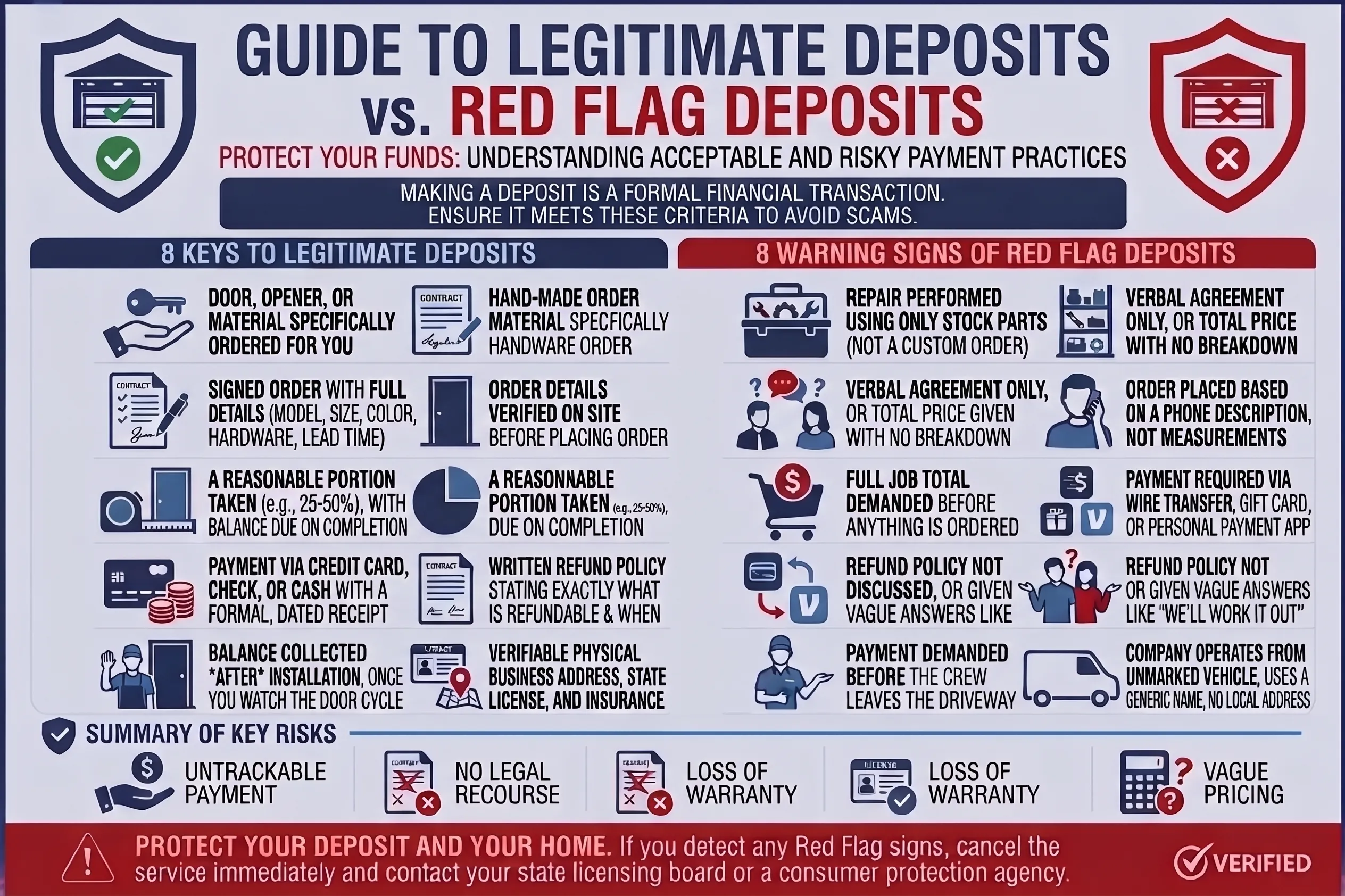
Element | Legitimate | Red flag |
What it is for | A door, opener, or material being made or ordered for you | A repair using stock parts |
Paperwork | Signed order naming model, size, color, glass, hardware, lead time | Verbal agreement, or a total with no breakdown |
Measurement | Taken on site before the order is placed | Order placed from a phone description |
Amount requested | A portion, with the balance due on completion | The full job total before anything is ordered |
Payment method | Credit card, check, or cash with a proper receipt | Wire, gift card, or a personal payment app |
Cancellation terms | Written, stating what is refundable and when | Not discussed, or “we will work it out” |
Balance due | After installation, once you have watched the door cycle | Demanded before the crew leaves the driveway |
Company identity | Verifiable address, license, and insurance | Unmarked vehicle, generic name, no local address |
Two or three red-flag columns together is a pattern, not bad luck. The International Door Association’s scam awareness resources track news coverage of exactly this behavior, including reporting on schemes that have targeted Illinois homeowners, and Clopay’s guide to avoiding garage door scams notes that these operations frequently have no legitimate physical location behind the phone number.
A practical note on payment method: pay deposits by credit card when you can. It is the only method that gives you a dispute process if the door never arrives. A cash deposit with no itemized receipt leaves you with nothing to point at.
Before you hand over a deposit
Confirm the company is licensed and insured and operates from a real local address you can find on a map. Get the order in writing with the door fully specified. Read the cancellation terms. Ask what the lead time is and what happens if it slips.
Vetting takes less time than most people expect, and it is covered in more depth in our guide to choosing the best garage door company in Rockford, IL. The International Door Association’s industry alert on LinkedIn is another place the trade has been publicly flagging operations that take deposits and disappear.
Done properly, a new door is one of the better returns available on a home, both in daily use and at resale, which is the practical case laid out in the advantages of getting a new garage door. The deposit is not the risky part. The company you hand it to is.
Rockford Door Company is a licensed and insured local company at 1016 23rd St in Rockford, serving Rockford, Loves Park, Machesney Park, Belvidere, Roscoe, Rockton, Cherry Valley, South Beloit, and Beloit, WI. Every job starts with an on-site inspection and a plain-language walkthrough of your options before anything is ordered.
Planning a new door and want the order spelled out properly? Schedule a consultation with Rockford Door Company or call 1-815-397-5903.