
No. You should never pay a garage door repair bill in full before the work is finished. A legitimate company gives you a written estimate, does the job, then bills you. There is one real exception: a deposit on a custom or special-order door, which is standard because the manufacturer builds that door specifically for your opening. The difference matters. A deposit on a made-to-order door is normal business. Full payment demanded on a springs-and-cables repair before a wrench is turned is one of the most reliable warning signs in the trade.
Key takeaways
- Repair work is billed after completion. If someone wants the whole amount before starting, stop and get a second quote.
- A deposit on a custom door order is legitimate. A deposit on a same-day repair usually is not.
- Get the estimate in writing before you agree to anything, including the service call fee.
- Scam operations concentrate on emergencies, because a homeowner with a door stuck open at 9pm will agree to almost anything.
- Untraceable payment methods (wire, gift card, personal payment app) mean you have no way to dispute the charge later.
- Knowing the normal price range for common repairs is the single best defense you have.
The garage door industry has a documented problem here. The International Door Association’s scam awareness resources track news coverage of these operations across the country, including reporting on schemes that have hit Illinois homeowners directly. The pattern is consistent: target people in an emergency, quote low on the phone, then inflate the bill once a technician is standing in the garage.
Here are the eight warning signs, ordered by how often they actually show up.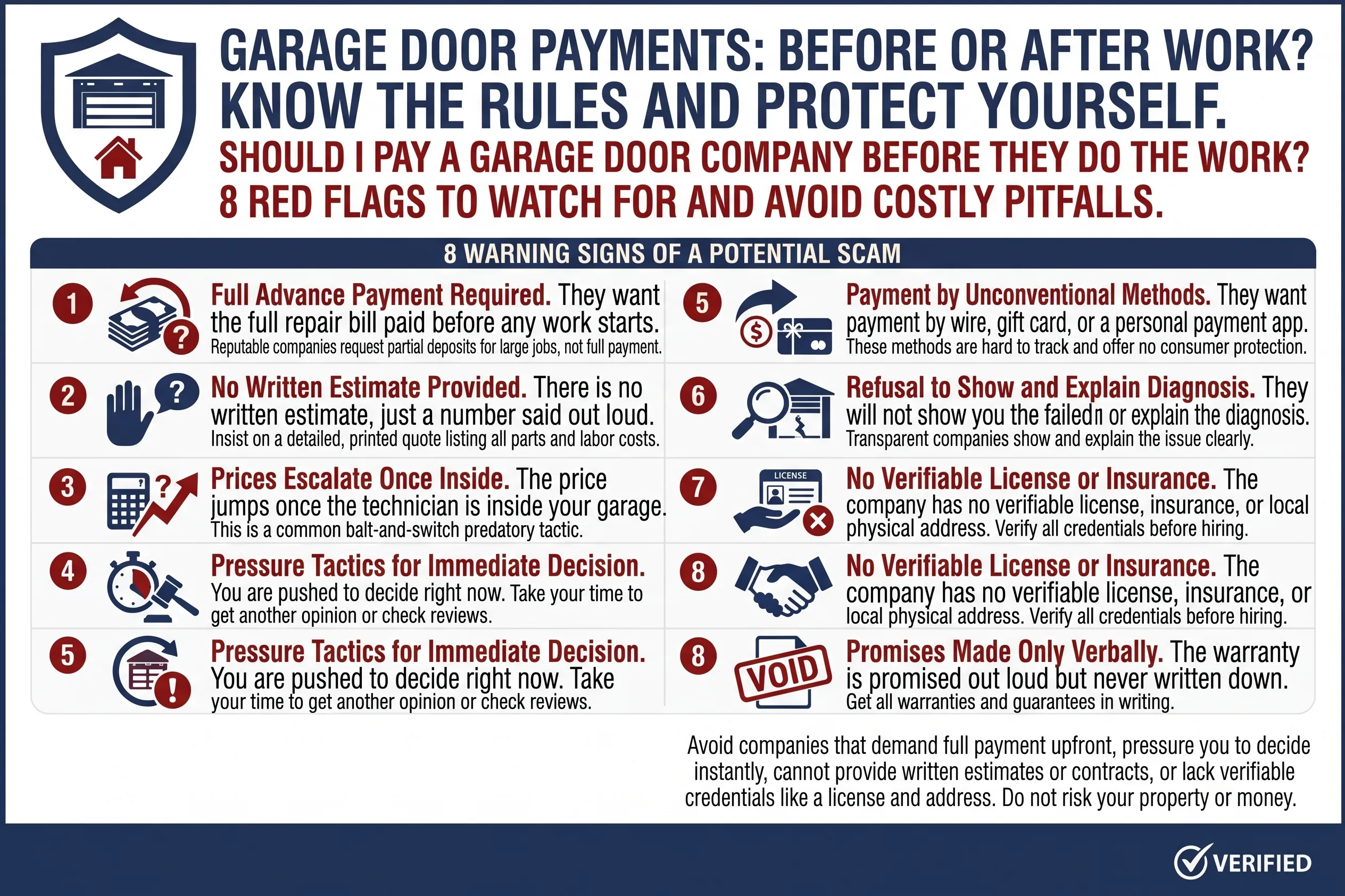
1. They want the full repair bill paid before any work starts
What it looks like: The technician arrives, looks at the door, names a price, and asks for the entire amount before opening the toolbox. Sometimes it is framed as company policy. Sometimes it is framed as a discount for paying now.
Why it happens: Once they have your money, their incentive to finish the job correctly disappears. In the worst cases, the work never gets done at all.
What to do instead: Say you are happy to pay when the work is complete and inspected. A real company will not blink at this, because it is how the trade operates. If the answer is that they cannot start without full payment, that is your cue to end the visit.
Why paying a garage door repair bill in full upfront puts you at risk
Repair work is not manufactured to order. The parts are stock items a company already carries on the truck. There is no supply chain reason to collect money in advance, which is exactly why the request stands out. New door orders are a different situation entirely, and that distinction is worth understanding before you decide: Is a Deposit Normal for a New Garage Door? 6 Times Paying Upfront Is Fine. If you are having a new door put in rather than a repair done, review how a legitimate garage door installation job is normally scheduled and billed.
2. There is no written estimate, just a number said out loud
What it looks like: You ask what it will cost. You get a verbal figure. Nothing is written down, nothing is emailed, and there is no itemized breakdown of parts and labor.
Why it happens: A verbal number cannot be held against them. When the final invoice arrives at triple the quote, there is no document proving what you were told.
What to do instead: Ask for the estimate in writing before work begins, even if it is just a photo of a handwritten work order or a text message. It should list the parts, the labor, the service call fee, and the warranty terms.
How to get a written garage door repair estimate before you agree
A written estimate is only useful if you can tell whether the number on it is reasonable. Most homeowners have no reference point, and scam operations depend on that. Build yourself a baseline first: How Much Should a Garage Door Repair Cost? 7 Prices to Know Before You Say Yes. Ten minutes of reading turns a meaningless number into one you can evaluate.
3. The price jumps once the technician is inside your garage
What it looks like: You were quoted a modest service call on the phone. Once the technician is on site, the diagnosis expands. Suddenly you need new springs, new cables, new rollers, a new opener, and the total has multiplied.
Why it happens: This is the core mechanic of the scam. The low phone quote buys access to your garage. Clopay’s own homeowner guide to avoiding garage door scams flags this specifically: operations advertise a cheap service call, then add charges after arrival.
What to do instead: Ask why each additional part is necessary and ask to see the failure. If the answer is vague or rushed, pause the job. You are allowed to say “I want a second opinion before you start.”
Why a garage door repair quote goes up after the tech arrives
Sometimes a quote legitimately increases, because a phone diagnosis is a guess and a visual inspection is not. The difference between a legitimate revision and a bait and switch comes down to whether the technician can show you the problem. The full breakdown is here: Why Was My Garage Door Repair Bill Higher Than the Quote? 6 Tactics to Watch For. Springs are the most common vehicle for this upsell, so it helps to understand what actually causes a garage door spring to break before someone tells you yours did. The same applies to openers, where a repair is frequently pitched as a full replacement even when the existing unit is serviceable. Knowing what a modern garage door opener actually costs and does makes that conversation much easier.
4. You are pushed to decide right now
What it looks like: Today-only pricing. A warning that the door is about to fall. A claim that the crew is leaving town tomorrow. Anything designed to remove your ability to think.
Why it happens: Urgency short-circuits comparison shopping. A homeowner who calls two other companies will usually discover the quote is inflated, so the goal is to prevent that call.
What to do instead: Genuine safety hazards exist, and a technician should be able to explain the specific risk in plain terms. But “you need to decide in the next five minutes” is a sales tactic, not a safety warning.
How to handle high-pressure garage door repair sales tactics
Real emergencies do happen. A broken garage door spring is a genuine emergency in the sense that the door becomes unsafe to operate, and you should not try to lift it manually or run the opener. But an emergency means stop using the door, not sign this contract immediately. Those are not the same thing. Even under real time pressure, you can secure the door, leave it closed, and take an hour to get a second quote.
Safety note: Never attempt to adjust or replace torsion springs yourself. They store enough energy to cause serious injury or death. This is not a DIY repair under any circumstances.
5. They want payment by wire, gift card, or a personal payment app
What it looks like: No card reader. A request to send money to an individual’s account rather than a business. Cash only, with a discount attached.
Why it happens: These methods are effectively irreversible. Once sent, the money is gone, and there is no chargeback process to recover it.
What to do instead: Pay by credit card whenever possible. It gives you dispute rights that no other method does. A legitimate company processes card payments as a matter of course.
Why untraceable garage door repair payments leave you with no recourse
Cash itself is not a red flag. Plenty of established companies take cash. The signal is cash instead of every other option, combined with a discount for using it, combined with no invoice. One of those alone means little. All three together is a pattern.
6. They will not show you the failed part or explain the diagnosis
What it looks like: The technician replaces something, but will not show you the old component, will not let you photograph it, or takes it with them without explanation.
Why it happens: Because the part often was not broken. Charging for unnecessary replacements is the most profitable version of this scam, and physical evidence undermines it.
What to do instead: Ask to see the failed part before it is replaced and again after it is removed. Ask to keep it. A technician who is confident in the diagnosis will walk you through it.
How to verify a garage door part actually needed replacing
Most garage door failures are visible once you know what to look for. A broken torsion spring shows a clear gap in the coil, and you can check the signs of a broken spring yourself from a safe distance without touching anything. Opener components are similar, and a basic familiarity with the parts inside a garage door opener makes it much harder to be sold a circuit board you did not need. If the diagnosis points to the opener specifically, a straightforward garage door opener repair is very often the correct fix rather than a full unit replacement.
7. The company has no verifiable license, insurance, or local address
What it looks like: An unmarked truck. A generic company name that is hard to pin down. A website address that does not correspond to a real location. A phone number that gets answered with a different business name than the one you called.
Why it happens: These operations are built to be untraceable. If you cannot identify the business afterward, you cannot pursue it. The Clopay guide notes that scam operations frequently lack a legitimate physical showroom and use inconsistent or generic names across their advertising.
What to do instead: Before the appointment, search the business address on a map and confirm it is a real commercial location. Confirm the name they answer the phone with matches the name on the website. Ask for proof of insurance.
How to check if a garage door company is licensed and insured
Verification takes about five minutes and it is the highest-value five minutes in this entire process. The International Door Association’s industry alert on LinkedIn is one place the industry has been publicly flagging these operations. For a fuller walkthrough of what separates an established local contractor from a call center with a spreadsheet of technicians, see our guide on choosing the best garage door company in Rockford, IL.
8. The warranty is promised out loud but never written down
What it looks like: You are told the springs carry a multi-year warranty. It appears nowhere on the invoice, and no paperwork is left behind.
Why it happens: A verbal warranty from an untraceable company is worth nothing. When the part fails in eight months, there is no one to call.
What to do instead: Require the warranty terms in writing on the invoice, including what is covered, for how long, and whether labor is included. Parts-only warranties are common and legitimate, but you should know that is what you are getting.
Why a garage door repair warranty has to be in writing
The warranty is often the clearest signal of whether a company expects to still exist next year. An established local company backs its work because it depends on repeat business and referrals in the same zip codes. That is also the standard you should hold any garage door repair provider to before you sign anything.
Legitimate payment request vs. red flag
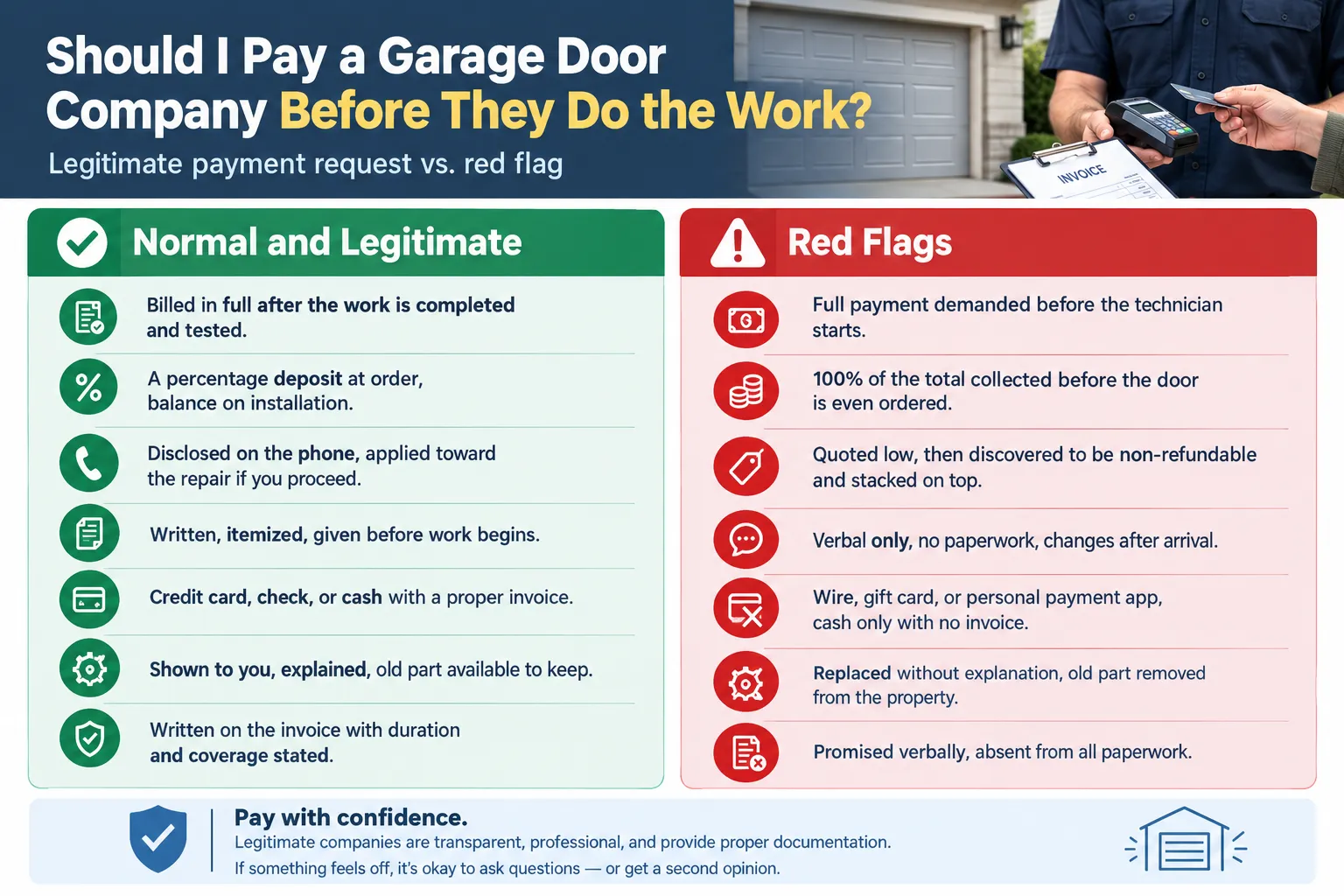
Situation | Normal and legitimate | Red flag |
Same-day spring or cable repair | Billed in full after the work is completed and tested | Full payment demanded before the technician starts |
Custom or special-order door | A percentage deposit at order, balance on installation | 100% of the total collected before the door is even ordered |
Service call fee | Disclosed on the phone, applied toward the repair if you proceed | Quoted low, then discovered to be non-refundable and stacked on top |
Estimate | Written, itemized, given before work begins | Verbal only, no paperwork, changes after arrival |
Payment method | Credit card, check, or cash with a proper invoice | Wire, gift card, or personal payment app, cash only with no invoice |
Additional parts found on site | Shown to you, explained, old part available to keep | Replaced without explanation, old part removed from the property |
Warranty | Written on the invoice with duration and coverage stated | Promised verbally, absent from all paperwork |
Not every one of these on its own proves bad intent. Two or three together almost always does. If you are unsure whether your situation warrants bringing someone out at all, it helps to know when to call a garage door repair professional in Rockford versus when the problem is something you can safely check yourself.
The short version
Repair work gets paid for when it is finished. Custom doors get a deposit. Everything else is negotiable, and everything should be in writing. If a company will not put a number on paper before starting, or will not show you the part it says failed, you have not found a bargain. You have found the setup.
The most durable protection is not vigilance during the emergency, it is not having the emergency in the first place. A door on a regular service schedule fails less often and fails less dramatically, which means you are far less likely to be making a rushed financial decision in your driveway on a Sunday. Our garage door maintenance checklist homeowners can follow covers what to check and how often.
Rockford Door Company has served homeowners across Rockford, Loves Park, Machesney Park, Belvidere, Roscoe, and the surrounding Winnebago County area with licensed, insured technicians, written estimates, and no payment collected until the work is done and you have seen it operate.
Need a real quote from a real local company? Contact Rockford Door Company for an estimate. Written pricing before we start, same-day service available.